

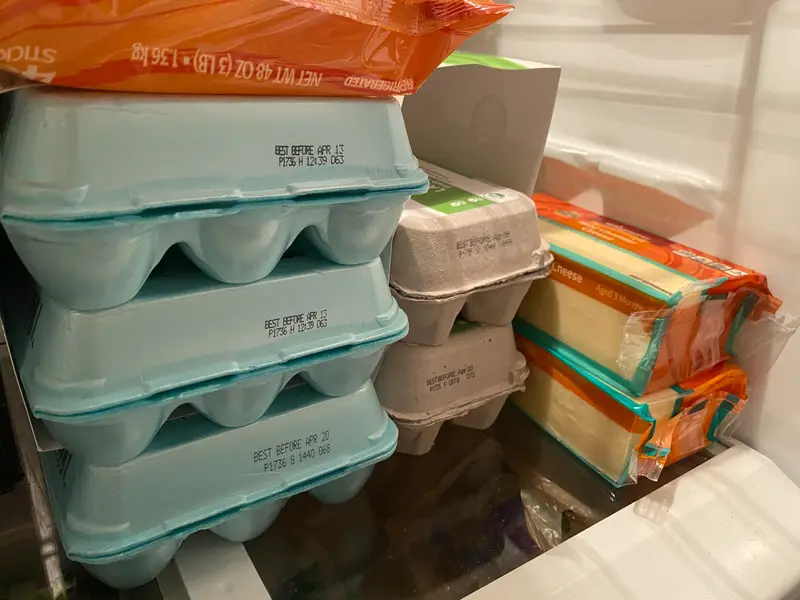
The pot is bubbling, you’re already running late, and you grab the carton off the fridge shelf and tip six cold eggs into the water. Ten seconds later a ghostly white streamer is swirling around the pan like a jellyfish, and you know exactly which egg is going to come out looking like it lost a fight.
That mess has a cause, and it is the temperature of the egg when it hits the water. An egg going from refrigerator cold into a rolling boil makes a jump of roughly 170 degrees Fahrenheit at the shell in about a second, and a shell is a brittle thing that does not love surprises. The fix costs nothing and takes no extra work: pull the eggs out of the fridge when you put the pot on the burner. By the time the water is boiling, five minutes or so later, they have lost some of the chill.
Doing it that way also tends to give you an egg that peels in two pieces instead of coming off in forty angry little flakes with half the white attached. So there are two reasons to stop the fridge-to-boil habit, and zero reasons to keep it.
What A Cold Egg Does In Hot Water
An eggshell is mostly calcium carbonate, and it is strong in the way a dinner plate is strong: fine until you stress it unevenly. Drop a cold egg in boiling water and the outside of the shell heats and expands faster than the membrane and the contents behind it. That mismatch builds stress the shell cannot always absorb, and micro-cracks can open in seconds, hidden until the white starts to set and leak out through them.
The comparison everybody reaches for is pouring hot water on a frozen windshield, and it holds up. Letting the egg sit out first narrows that gap, though a few minutes on the counter only takes a few degrees off it.
The Air Pocket At The Fat End
Heat is only half the story. Every egg has a small air sac at the wide, blunt end, formed as the contents cooled and contracted after the egg was laid. Heat that air and it expands, pushing out against a shell that does not move.
That is why so many cracks show up at the big end. It is also why the carton that has been sitting in your fridge door for three weeks gives you more trouble. Moisture slowly evaporates through the porous shell as an egg ages, the air cell grows, and a bigger pocket means more air shoving outward when the heat hits.
Two Eggs From The Same Carton Are Not The Same Egg
Shells vary more than you would think. Thickness and durability depend on the breed of the hen, her diet and especially her calcium intake, and her age. Older hens lay eggs with thinner shells. Shape and microstructure matter too.
Two eggs sitting side by side in the same twelve-pack can have meaningfully different shell strength. One sails through a rough boil and the next one splits. You cannot see the difference, which is why the goal is to make the whole process gentler rather than hunting for the weak egg.
Get Them Out Of The Fridge Early
The easiest version of this requires no planning at all. Take the eggs you want out of the fridge at the same moment you set the water on to heat, and they will have warmed up a little by the time it comes to a boil. Fifteen to twenty minutes on the counter is better if you have it.
In a hurry, put the eggs in a bowl and cover them with tepid water for five to ten minutes. Running them under warm tap water for a minute or two works as a last-ditch move. Warm, not hot. You are closing the gap, not cooking them in the sink.
The Cold Water Start, Which Skips The Problem Entirely
If cracked eggs are a weekly annoyance in your kitchen, change the method instead of babysitting the temperature. Put the eggs in the pan first in a single layer, cover them with about an inch of cold tap water, bring it to a boil, then kill the heat, put the lid on and let them sit about 12 minutes for large eggs, less for medium and more for extra-large, before they go into an ice bath. The eggs and the water warm up together, so there is no shock to speak of.
A heavy-bottomed saucepan heats more evenly than a thin pot that throws hot spots at whichever egg is unlucky enough to be sitting on one.
Plenty of good cooks still prefer the hot start, lowering warmed eggs into already-boiling water, because of how the yolks turn out. That is a real preference and not a mistake. The mistake is doing it with eggs straight out of the fridge.
Stop Letting The Water Rage
A hard rolling boil knocks eggs into each other and into the bottom of the pan, and every one of those little collisions is a chance to start a crack that pressure then finishes. Turn the heat down a notch once the water is going so they stop bouncing around.
Lower the eggs in one at a time with a slotted spoon instead of tipping them in from the carton. Keep them in a single layer rather than stacked. A folded kitchen towel in the bottom of the pan cushions the landing if you are working with a thin pot or a full dozen.
Salt And Vinegar Are Insurance, Not Prevention
A teaspoon of vinegar in the water will not keep a shell from cracking. What it does is damage control. The acid makes any escaping white set fast, sealing the crack from the inside before you get a cloudy pot and a half-empty egg. Salt does a similar job.
Plain white vinegar does not change the taste of the egg, so there is no reason not to use it as a backup. And an egg that cracks mid-boil is still perfectly good. The USDA says eggs that crack during hard boiling are still safe to eat. It just looks ragged.
The Thumbtack Trick Barely Does Anything
Poking a pinhole in the blunt end to vent the air sac is one of those tips that gets passed around forever. The logic is fine. The evidence that it works is thin.
It does not hurt anything, and piercing the shell may earn its keep with older eggs that have bigger air sacs. Just do not expect a pin to rescue a dozen ice-cold eggs dumped into a rolling boil.
Warm Eggs Peel Better, And So Do Old Ones
The temperature gap between a cold egg and hot water can also make the white grab onto the inside of the shell, which is how you end up throwing away a third of the egg in the sink. Freshness matters even more. A very fresh egg has a lower-pH white that clings hard to the inner membrane, and the egg loses carbon dioxide as it ages, which loosens that grip.
Save the newest carton for frying and boil the one that has been in there a week or two. For very fresh eggs, some cooks add a teaspoon of baking soda to the water to raise the pH. Afterward, move them straight into ice water for at least five minutes so the egg contracts away from the shell. Then tap both ends on the counter, roll the middle, and the shell should come off in a sheet. Do not overcook them unless you want the gray-green ring around the yolk and the sulfur smell that shows up a day later in the fridge.
Not Everybody Buys The Thermal Shock Story
There is a dissent worth hearing. Dr. Peter Aitken, who runs the Kitchen Myths site, argues that heat shock is not what breaks eggs. His reasoning: a shell that expands is relieving pressure on the contents, not building it, and a shrinking shell is the bigger risk, which happens later in the ice bath when a crack no longer matters.
He points to a Julia Child television demonstration he watched, in which she moved raw eggs from an ice water bath directly into simmering water and not one of them cracked. In his view the real causes are invisible cracks already in the shell from rough handling during production and shipping, eggs dropped into the pan rather than lowered, and eggs bouncing around in water at a hard boil. Bringing eggs to room temperature, he writes, will not prevent cracking, although it does no harm.
What To Actually Do Tomorrow Morning
Both camps land in the same place on the things that matter most: be gentle, and do not cook at a violent boil. Simmering water, a slotted spoon, a single layer of eggs and a quick look for hairline cracks before anything goes in the pot will solve most of your problem on their own.
Taking the carton out when you turn on the burner is free, it costs you five minutes of nothing, and the worst case is that it does not help. The best case is intact shells and whites that let go cleanly. If the eggs have to look perfect, deviled eggs for a party, say, boil two extra. The ones that split still make excellent egg salad.
