

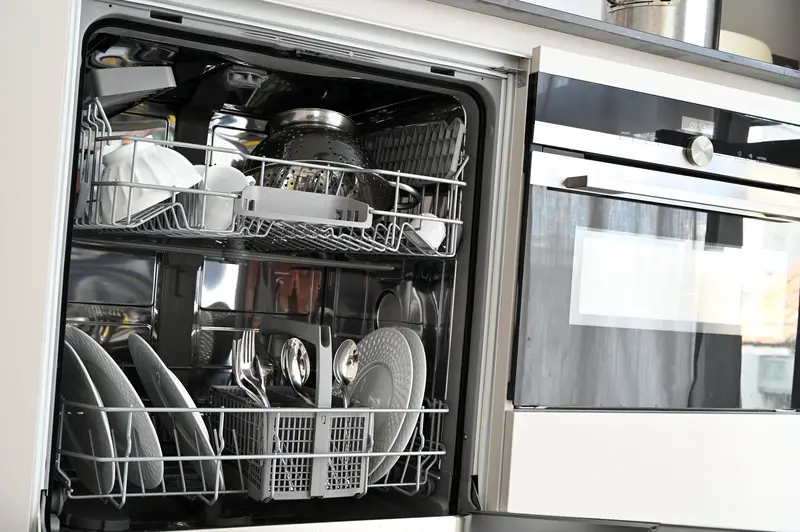
The dishwasher might be the greatest thing to ever happen to a lazy Sunday. You scrape, you stack, you press a button, and forty minutes later everything’s clean while you’re on the couch. So it makes total sense that you’d want to cram every single dirty thing in your sink into it. Here’s the problem. Some stuff comes out ruined, and you won’t always notice right away. A few items get wrecked the very first time. Others die a slow death over months while you stand there wondering why your nice pan suddenly looks like a gas station relic. Here’s exactly what to keep out of the machine, and why it matters for your wallet.
Cast Iron Skillets
If there’s one thing every appliance company, every chef, and every grandma on earth agrees on, it’s this. Cast iron and dishwashers are sworn enemies. That black, slick coating on your skillet took real time and cooking to build up, and a wash cycle takes it off. Lodge puts it plainly: a dishwasher will remove the seasoning and likely cause rust. Maytag says cast iron and steel are susceptible to rusting and should typically not go in. The fix takes two minutes. Wash it by hand in warm, soapy water with a stiff brush, dry it right away, and rub a thin coat of oil over the surface. And yes, soap is fine. Lodge says so itself; modern dish soap is not strong enough to strip seasoning. The one exception is Lodge’s heat-treated serveware line, which is built for the machine.
Your Good Chef’s Knife
Toss your good chef’s knife in the dishwasher and you’re basically paying money to make it worse. It is not the heat that does it. Whirlpool and Consumer Reports both point at the same culprit: the blade knocking against everything else in the basket, which nicks the edge and dulls it, while detergent and standing water invite corrosion. A loose knife will also chew up the racks. Where heat does real damage is the handle, because it can melt the adhesive holding a hollow handle together. And a dull knife is the more dangerous one, since it slips instead of cutting. Hand wash in hot soapy water and dry it. Your cheap tableware forks and butter knives are fine in the machine. That $80 chef’s knife is not.
Nonstick Pans
This one trips up a lot of people. Consumer Reports does not say to hand wash every nonstick pan; it says that if the manufacturer has not called a pan dishwasher safe, keep it out, because the wash cycle can wear the coating away. Larry Ciufo, who has tested hundreds of dishwashers at CR over twenty years, is the one making that point. So check the pan before you check your instincts. The good news is nonstick is the easiest thing in your kitchen to clean anyway. A sponge, a little soap, warm water, done. Skip the scrubby steel pads because they scratch. And never drag a metal spatula across it. Wood, silicone, or plastic only.
Wooden Cutting Boards And Spoons
Wood and hot water do not get along. A wooden board can swell, warp, crack or come apart at the glue lines, and University of Maine Extension notes that boards with inlays or glued-up slabs are the ones most prone to separating. Whirlpool says the same about wooden utensil handles. It is a risk rather than a certainty, but it is not a risk worth running on a board somebody gave you. Wash wooden boards by hand, and here’s the part people skip: stand the board on its edge so air gets to both faces, and leave it until it is completely dry before putting it away. Don’t leave a wet one lying flat in the sink either. It’ll drink up water and swell like a sponge.
Stanley Cups And Insulated Mugs
Here the honest answer is: check yours, because the rule changed. Stanley now says all Quenchers are dishwasher safe, and Hydro Flask says the same of its current bottles. Older Hydro Flasks, the Trail series, and all their mugs are not. What is true across the board is that the vacuum seal between the two walls is the whole reason your coffee stays hot for six hours, and Consumer Reports warns that on a tumbler not labelled dishwasher safe, water can seep into that seal. Once it does, your $45 tumbler is a regular cup that sweats a ring onto your desk. So read the base. And if you are only drinking water out of it, rinse it daily, take it apart and give it a real soap-and-water wash about once a week.
Copper Mugs And Raw Aluminum
Copper is gorgeous and expensive, which is exactly why you shouldn’t gamble it in the dishwasher. Whirlpool says hand wash only, to avoid pitting and discoloration, and Moscow mule mugs count. Plain aluminum is the other loser. Maytag says non-anodized aluminum should stay out, and it comes back with grey marks or white spots. Consumer Reports pins those on minerals in the water and reckons a soap-filled steel wool pad will take them off, so it is ugly rather than terminal. The thing to be careful about is the supposed get-out: hard-anodized is not automatically fine. Calphalon marks whole lines hand wash only and says the dishwasher voids the warranty. Check your specific pan rather than the metal.
Fine China, Crystal, And Hand-Painted Plates
Grandma’s china, your wedding plates, crystal wine glasses, and anything with a hand-painted design or a gold rim. Keep all of it out. The heat and constant jostling can chip or crack delicate glass, and the movement is especially rough on stemware that clinks around all cycle. Gold trim and metallic accents can fade or wear. Food Network also flags any silverware with carved antler or bone handles. There is one more reason nobody mentions. California public health warns that if an old glazed piece contains lead, a dishwasher can damage the glaze, which makes it likelier to leach into food afterwards and can even contaminate other dishes in the load. Tableware alone is not a big exposure risk for most people, but it is a good reason to hand wash anything antique or brightly glazed rather than find out.
Cheap Plastic Containers
Not all plastic is doomed here. The sturdy stuff, like food processor bowls and thick mixing bowls, usually survives just fine. But thin, clear plastic containers, the kind takeout soup comes in or the cheap storage tubs from the dollar store, get scratched and cloudy fast. HGTV notes the high heat warps them and makes them brittle over repeated cycles. Worth knowing about the takeout tubs specifically: a cold-fill deli container was approved for holding cold food, not for a 150 degree wash and dry, so if it is not stamped dishwasher safe, do it by hand. If you do put plastic in, always set it on the top rack away from the heating element and skip the hottest cycles. That one habit saves half your Tupperware collection from an early grave.
The Instant Pot Lid, Which Is Actually Fine
Here is one you have probably been told to keep out, and you do not have to. Instant Brands says the lid and its accessories are top-rack dishwasher safe, and the inner pot goes in too. The part that must never see water is the base. Do not immerse the housing, the cord or the plug, and do not run it under the tap; wipe it with a barely damp cloth. The sealing ring is the other thing to keep an eye on, though for a different reason: Instant Brands says replace it every twelve to eighteen months, because it holds onto smells and it is what makes the seal. Take the lid apart, check the valve is clear, and let everything dry fully before it goes back together.
So What Actually Belongs In There
None of this means your dishwasher is bad at its job. ENERGY STAR reckons a certified machine uses less than half the energy of washing by hand, but the savings depend on how you run it: full loads only, and scrape rather than rinse, because pre-rinsing adds back the water you were trying to save. The trick is knowing what it’s built for. Everyday plates, glasses you don’t care about, regular forks and spoons, sturdy bowls, most stainless steel, and yes, your Instant Pot lid on the top rack, can all go in without a second thought. Cast iron, your good knives, anything wood, copper, raw aluminum, grandma’s china and any pan whose maker says hand wash get the two-minute wash instead. Think of the machine as a targeted tool, not a magic box that cleans literally everything you own. A year from now, you’ll be glad you’re not replacing pans and cups you never needed to lose.
