

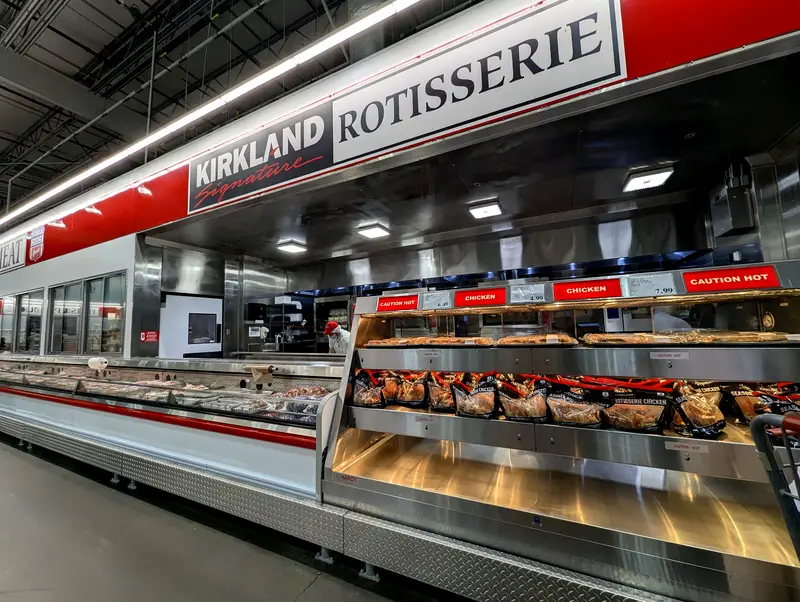
You know the routine. You walk into Costco for paper towels and a flat of water, and somehow you leave with a hot rotisserie chicken swinging from two fingers in that clear plastic clamshell. Five bucks. Dinner solved. It’s basically an American tradition at this point.
Well, that tradition just landed Costco in federal court. Not once. Twice.
Two separate lawsuits are circling the most popular bird in the country, and both make the same basic complaint: shoppers were told one thing on the sign while the ingredient list said something else. Neither case is going to stop you from grabbing a chicken next weekend. But once you know what the attorneys dug up, you probably won’t look at that clamshell the same way. Let me walk you through the whole thing.
That $4.99 Chicken Is Now A Courtroom Problem
Costco’s rotisserie chicken is famous for a reason. The company has held the price at $4.99 for years, even when everything else in the store crept up. It’s what people in retail call a loss leader, meaning Costco doesn’t really make money on it. The chicken exists to pull you through the door so you spend on the other stuff. And it works. Costco said at its annual meeting that rotisserie chicken sales topped 157 million birds worldwide in 2025.
So when two lawsuits hit that same product in the span of a few weeks, people noticed. One suit is about the label. The other is about the plant where the chicken comes from. One is a labeling fight and the other is a supply chain fight, and they landed within weeks of each other. Here’s what each one actually claims.
The No Preservatives Promise That Wasn’t
Walk past the deli case at a lot of Costco warehouses and you used to see it in big letters: No Preservatives. Simple message. You’re getting a plain roasted chicken and nothing weird added. That sign is now the center of a class action filed in federal court in San Diego.
Two shoppers, Anatasia Chernov and Bianca Johnston, say the Kirkland Signature Seasoned Rotisserie Chicken actually contains two additives: sodium phosphate and carrageenan. They argue those are preservatives, plain and simple, and they say they never would have bought the chicken if they’d known. Their attorney, Wesley Griffith, summed it up bluntly in a press release, saying people rely on clear claims like No Preservatives when they decide what to feed their families, and that Costco’s own ingredient list contradicts its own marketing.
The lawsuit doesn’t hold back on the money side either. It claims Costco has cheated customers out of tens, maybe hundreds, of millions of dollars by putting up a label that doesn’t match the box. What does sodium phosphate do? According to the filing, it buffers pH, holds moisture, and slows spoilage. Carrageenan holds texture and stretches shelf life. Both are common in deli meat, canned tuna, and fast food, so this isn’t some rare mystery chemical. The whole argument is about the word on the sign, not the safety of the food.
Costco Fires Back, And Quietly Changes The Signs
Costco isn’t rolling over. In June 2026 the company filed a motion to dismiss the preservative case, arguing the whole thing is a misreading of what those ingredients are. A Costco spokesperson said the company uses carrageenan and sodium phosphate to help the bird hold moisture, keep its texture, and stay consistent while it cooks, and that both are approved by food safety authorities.
But here’s the part I find telling. Costco also said it pulled all the No Preservatives statements from its store signs and its website. The company framed it as keeping the labels and the signage consistent. Read it however you want, but a giant retailer quietly scrubbing a marketing claim off every warehouse in the country while it fights a lawsuit is not nothing. As of the summer of 2026, the case is still alive and Costco is still pushing to get it thrown out.
The Second Lawsuit Nobody Saw Coming
While the label fight plays out in California, a totally separate case landed in Seattle federal court. This one is about the plant. The shoppers behind it say they bought Costco rotisserie chickens regularly and overpaid because the company never told them about contamination problems at the plant.
The plant in question is Lincoln Premium Poultry in Fremont, Nebraska, which Costco built and owns to supply its own birds. Here is the part that gets misreported. Those numbers you may have seen, 9.8% for whole chickens and 15.4% for parts, are not what the Fremont plant measured. They are the USDA’s maximum allowable positivity rates for salmonella, the pass or fail line every plant is held to, and the complaint concedes the plant’s actual rates are not public. What the suit argues is that Fremont kept landing on the wrong side of that line. It cites Farm Forward, a group campaigning against factory farming, which reviewed federal inspection data and found the plant in the worst rating category month after month, and Consumer Reports, which put it on a 2025 list of the most contaminated poultry plants in the country. Farm Forward’s most recent window, December 2024 to November 2025, moves the plant out of that worst category and into the middle one.
The lawsuit is asking for compensatory and triple damages for anyone who bought Kirkland Signature rotisserie chicken or raw chicken parts from January 1, 2019 onward. Its core argument is a money argument dressed as a trust argument: shoppers paid full price believing they were getting one thing, and the company owed them the full story.
What’s Actually In That Bird Besides Chicken
Here’s a thing most people don’t realize until they read the label on the bottom of the tray. Your grocery store rotisserie chicken is almost never just chicken. It’s chicken plus an injection solution, and this is true across the board, not only at Costco.
Tom Super, a senior vice president at the National Chicken Council, said it flat out: basically all rotisserie chickens are enhanced with a solution injected right into the bird. That solution can carry natural flavors, added sugar, gums, carrageenan, and a big load of salt. When Consumer Reports went through the labels on rotisserie chickens from seven supermarkets and warehouse clubs back in 2021, most of them had way more ingredients than just chicken. Its newer 2026 round found the same pattern, with one exception worth noting: the Whole Foods bird was not injected at all.
Why should you care as a shopper? Because that solution is partly water weight, and salt water is cheap. When a bird is pumped full of a seasoned brine, some of what you’re paying meat prices for is the liquid holding it together. It also explains why two birds that look identical can taste completely different. One might be juicy and seasoned, another might taste like it swam in the ocean. Sam’s Club’s Member’s Mark seasoned bird, for example, packs 550 milligrams of sodium into a small three ounce serving, and almost nobody eats just three ounces.
The Stores Doing It With Fewer Ingredients
Not every rotisserie chicken is loaded up the same way, and this is where you can actually make a smarter pick. In that 2021 round, the birds pumped with the most salt water were Sam’s Club at 550 milligrams per serving and Costco’s Kirkland Signature at 460. Those figures are five years old now, and the 2026 test shuffled the order, so treat them as a snapshot rather than a current ranking.
On the other end, a few stores keep the ingredient list short and honest. The standout was Kroger’s Simple Truth rotisserie chicken, which came in at just 40 milligrams per serving, with an ingredient list of chicken, sea salt, and water. That’s it. Whole Foods sells a plain original bird at 70 milligrams, and Wegmans has an organic option around 95 milligrams. The gap between the lightest and heaviest bird is more than thirteen times over. Same section of the store, wildly different product. If you want closer to real roasted chicken, flip the tray over and read the sticker before you toss it in the cart.
How Long That Chicken Really Lasts
One more warning that has nothing to do with lawyers and everything to do with your fridge. That warm bird has a clock on it the second it leaves the case. The USDA says cooked chicken shouldn’t sit at room temperature for more than two hours, and only one hour if it’s above 90 degrees out. The trouble zone runs from 40 to 140 degrees, which is exactly where a chicken slowly cooling on your counter or in a hot car ends up living.
Once it’s in the fridge, you’ve got three to four days, not five, even if it still looks and smells fine. Store it in an airtight container, write the date on it if you’re forgetful like me, and let it cool a bit before it goes in, but don’t let that cooling stretch past the two hour mark. If you know you won’t finish it, pull the meat off the bones and freeze it in portions. Shredded chicken freezes great and drops right into soup or tacos later.
So Should You Stop Buying It?
Honestly? I’m still going to grab one now and then. The point of all this isn’t to scare you off the deli case. It’s to make you a sharper shopper. The lawsuits are a reminder that a big sign in a warehouse is marketing, not gospel, and Costco quietly yanking its No Preservatives claim tells you plenty about how confident it was in that message.
So do three things. Flip the tray and read what’s actually injected into your bird. Know that the short ingredient lists at places like Kroger and Whole Foods exist if you want them. And get that chicken home and cold before the two hour window closes. Do that, and the most famous five dollar dinner in America goes right back to being a pretty good deal.
