

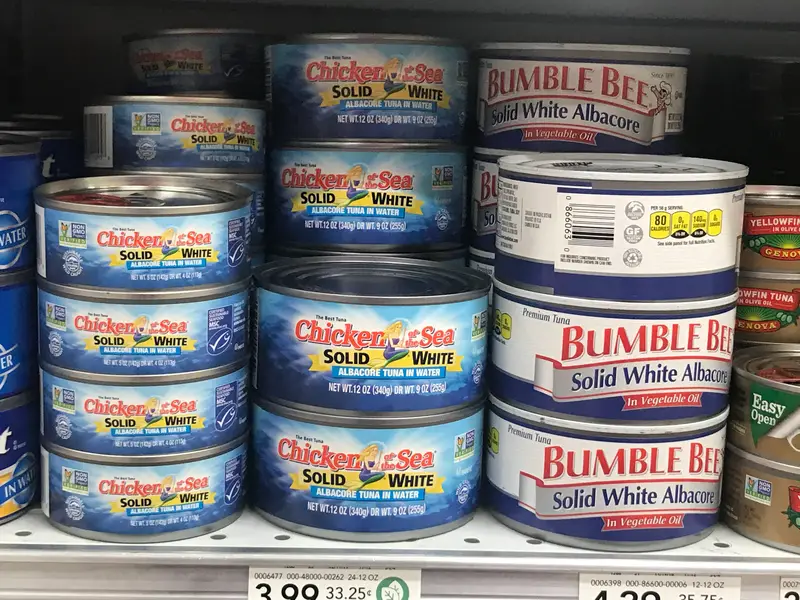
Canned tuna might be the most reliable thing in your kitchen. It’s cheap, it stacks neat in the pantry, and it turns into a sandwich in about a minute flat. Americans eat roughly a billion pounds of the stuff a year by the National Fisheries Institute’s estimate, which puts canned tuna third among the seafood we eat, behind shrimp and salmon.
But that “good forever” reputation people give it is a little bit of a lie. Cans fail. Seals break. And sometimes the tuna is a problem even when the can looks totally fine sitting on the shelf. Before you crack open your next one, here’s what should make you stop and think twice.
When The Lid Bulges Or Pops Up
The very first thing to look at is the shape of the can. A lid that bulges, swells, or looks puffed out is a hard no. That little dome usually means bacteria are growing inside and releasing gas, and the gas has nowhere to escape. Same story with a lid that clicks or pops when you press on it. Neither of those is normal, and neither is worth the gamble.
Pay extra attention to dents on the top lid specifically. A dent right on the lid can quietly release the pressure seal, and once that happens, bacteria have a way in. Plenty of grocery stores knock a few cents off dinged-up cans and stick them on a clearance rack. Fine for a lot of things, but a dented lid is not the one to save money on. Just grab a clean can and move on.
Rust And Dents In The Wrong Places
Flip the can over and give the whole thing a look. Not all rust is equal, though. Surface rust you can rub away with a paper towel is not a safety problem and the food inside is fine. Deep rust that has pitted the metal is a different story, and so is any rust you find on the inside of the lid when you open it. Those cans go in the trash whatever the date says.
Deep dents matter too, especially the ones along the seams or on the top and bottom edges. Those are the spots holding the seal together, so a crease there is a bigger deal than a ding in the flat side. A leaking can is the most obvious version of the same problem. If there’s any liquid seeping out or crust around a spot, the seal has failed, and the whole point of canning (that airtight pressure lock) is gone. When a can looks compromised, you can’t trust what’s inside it, so don’t.
What The Meat Should Never Look Like
Say the can passes every outside check and you pop it open. Now look at the actual tuna. Good canned tuna is light in color and holds together in flakes and chunks. Bad tuna basically tells on itself.
Watch for dull, mushy coloring and meat that’s fallen apart into loose, separated flakes instead of holding any shape. One thing worth unlearning here: brown or almost black lines running through the meat are not a warning sign. That is dark muscle, the bloodline, and it is ordinary tuna anatomy. The FDA’s own standard for canned tuna treats it as normal, and Dark is a legal colour grade you can buy on purpose. Plenty of perfectly good cans get binned over it.
The Smell And Taste Check
One caveat before any of this: none of it clears a can that has been recalled. Your nose cannot rule out the thing that actually hurts people. With that said, canned tuna already smells like fish. That’s normal, and it’s not what you’re checking for. What stands out is a rancid, sour, or sharp acidic smell that’s clearly different from the regular fishy, meaty odor. If it hits you wrong the second you peel back the lid, believe your nose and stop right there.
What there is not is a taste test. Do not try a little to see. Botulinum toxin has no taste and no smell, and the CDC is blunt about it: even a small amount in your mouth can be enough to make you seriously ill. Spitting it out does not undo it. This is where the old rule really earns its keep: when in doubt, throw it out. Nobody wants to spend a night on the bathroom floor over a two-dollar can of fish. The math there is not complicated.
The Recall Where Nothing Looks Or Smells Wrong
Here’s the part this whole article is really about. Every sign above assumes that bad tuna looks bad or smells bad. Sometimes it doesn’t, and that’s the situation happening right now.
In January 2026, Tri-Union Seafoods warned shoppers about Genova brand tuna after a third-party distributor accidentally shipped out cans that were supposed to stay quarantined from an earlier February 2025 recall. The root of it is a defect in the “easy open” pull-tab lids that can break the product seal over time. A broken seal opens the door to Clostridium botulinum, the bacteria behind botulism.
And this is the kicker. The FDA and the company are saying the exact same thing: do not eat these cans even if they look and smell completely normal. This kind of contamination doesn’t change the color, the smell, or the taste, so “trust your nose” does nothing for you here. The danger is invisible. That’s why the can codes are the only reliable way to check.
Which Cans To Pull Off Your Shelf
If you buy Genova, go dig through your pantry right now. Two products are named. The first is Genova Yellowfin Tuna in Olive Oil, 5-ounce cans sold in a 4-pack, UPC 4800073265, with can code S84N D2L and a “Best if Used By” date of January 21, 2028, or code S84N D3L dated January 24, 2028.
The second is Genova Yellowfin Tuna in Extra Virgin Olive Oil with Sea Salt, 5-ounce cans, UPC 4800013275, can code S88N D1M, “Best if Used By” January 17, 2028. The codes are printed on the bottom of the can or on the four-pack itself, so that’s where to look.
These cans landed on shelves at Meijer in Illinois, Indiana, Kentucky, Michigan, Ohio, and Wisconsin; Giant Foods in Maryland and Virginia; and Safeway, Albertsons, Vons, and Pavilions in California. Tri-Union said in late January 2026 that no illnesses had been reported, which is good news, but if you’ve got a match, don’t open it. Return it to the store or throw it out.
Do Not Stop At Genova
The February 2025 recall that started all this is still open, and it named four labels, not one: Genova, Van Camp’s, H-E-B and Trader Joe’s. Tri-Union Seafoods pulled them from Costco, Walmart, Kroger, Publix, Safeway, Harris Teeter and independent grocers across 26 states and Washington DC. Same defective pull-tab lid, same warning about cans that look and smell perfectly fine. It was never every can of those brands, though, so this is a code check and not a purge. The FDA notice lists the UPCs and can codes, all of them carrying Best if Used By dates between December 2, 2027 and January 27, 2028.
How Long Opened Tuna Actually Lasts
Once a can clears every check and you dig in, the clock starts. Leaving it in the open can is safe, whatever you have heard. The USDA says so outright. It is a flavour question rather than a safety one, because the metal can throw a tinny note into the fish.
Move it into an airtight container instead. Glass is great because it doesn’t hold onto odors and it seals well, but a plastic container with a tight lid works fine too. Pick one that roughly matches your portion so there’s less air trapped inside, then push it toward the back of the fridge where the temperature stays steadiest, at or below 40 degrees. Kept cold, opened tuna is good for about three to four days. Stick a piece of tape on it with the date if you’re the forgetful type. Past that window, don’t play detective. Just chuck it.
None of this should scare you off canned tuna. It’s still one of the best cheap meals going, and the vast majority of cans are exactly fine. The whole move is just spending three seconds before you eat: check the can’s shape, look for rust and leaks, then eyeball the color and give it a sniff once it’s open. And if you keep Genova in the house, match your can codes against that recall list before anything else. A can runs a couple bucks. Being a little careful costs you nothing.
