

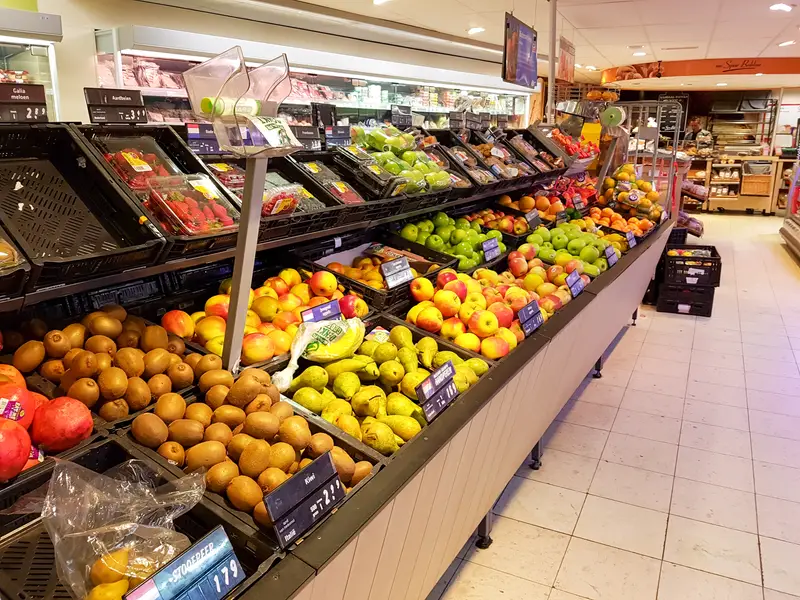
Somewhere right now there is a fruit sitting in a bowl on somebody’s kitchen counter, looking sweet and innocent, that packs more sugar than a full-size Snickers. That fruit is the mango. And once you know the number, you can’t un-know it. You will look at every mango slushie, mango salsa, and grocery store mango chunk a little differently for the rest of your life. Sorry in advance.
Fruit gets called “nature’s candy” and everybody nods along like it’s a compliment. But some fruits earn that name in ways you would not expect. Let’s go through the sweetest offenders, the sneaky ones you eat by the handful, and the few that barely move the needle at all.
The Mango Is The Sugar King (No Contest)
A single mango carries about 46 grams of sugar, which shakes out to roughly 11 teaspoons. Compare that to a regular Snickers at 28 grams, or a standard Hershey’s bar at 25 grams, and the fruit wins the sweetness contest by a mile. One dietitian put it in even wilder terms: a whole mango holds about the same sugar as 50 pieces of candy corn. Fifty. That is a small paper cup at a Halloween party, and it fits inside one piece of fruit.
Now, here is the part that keeps mango out of the villain seat. That same mango is about 83% water and comes loaded with fiber, so your body handles it a lot slower than a chocolate bar. A 2025 study out of George Mason University even fed one group of people a fresh mango every day and another group a low-sugar granola bar, and the mango group came out ahead despite eating way more sugar on paper. The mango, it turns out, is complicated.
Two Dates Equal A Milky Way
Dates are the fruit nobody suspects, and that is exactly why they get people. A single 1.84-ounce Milky Way bar has 32 grams of sugar. You know what else hits 32 grams? Two Medjool dates. Just two. They look wholesome, they get chopped into oatmeal and blended into “healthy” smoothies, and each one carries about 16 grams of sugar all by itself.
The difference from the candy is what comes attached. A 100-gram serving of dates (about four Medjools) hands you a chunk of your daily potassium, magnesium, copper, and vitamin B6, plus a little protein, which fruit almost never has. The fiber also means dates raise your blood sugar more gradually than a spoonful of table sugar would. That is why the classic trick of stuffing a date with a walnut or a smear of almond butter works so well. It slows the whole thing down and tastes like dessert.
Cherries And Grapes Are Sneaky
Nobody eats one cherry. Nobody eats one grape. That is the trap. A cup of sweet cherries sits around 18 grams of sugar, which sounds reasonable until you realize a big summer bowl of two cups jumps to about 36 grams, right in soda territory. And a bowl of cherries in front of the TV disappears faster than a bag of chips. You never feel like you overdid it because, well, it’s fruit.
Grapes play the same game. A full cup of seedless grapes runs about 23 grams of sugar, almost dead even with a standard Hershey’s bar’s 25 grams. The saving grace is the calorie count. That cup of grapes is only around 104 calories, while the Hershey’s bar clocks in near 210. So gram for gram of sugar you get roughly half the calories, plus water and fiber. Still, if you crush a whole clamshell of grapes standing at the fridge, you did the sugar equivalent of a couple candy bars without noticing.
Lychees, Pomegranate, And Pineapple Add Up Fast
Lychees are the pop-one-in-your-mouth fruit that gets away from you. A cup runs about 29 grams of sugar, and because they are small and easy to peel, you can blow through a whole cup while chatting and not think twice. Pomegranate arils land around 24 grams per cup, and those little ruby seeds are so satisfying to eat that portion control goes out the window.
Pineapple is another one. A cup of fresh pineapple chunks has about 16.3 grams of sugar, roughly the same as a slice of cherry pie. It tastes bright and tangy, which fools your brain into thinking it can’t possibly be that sweet, but the acid is just masking the sugar. None of this means you should skip these fruits. It just means “a cup” is a real portion, not a rounding error, and the numbers stack up when you go back for seconds and thirds.
Bananas, Oranges, And Pears Are In On It Too
Your everyday lunchbox fruits carry more than you would guess. A single banana has about 15.4 grams of sugar, which is right around what you get in a glazed donut. A large orange comes in at 17.2 grams, and a medium pear at 17.4 grams. A cup of grapes and a banana together and you have quietly passed a candy bar before you even ate lunch.
One thing worth knowing: ripeness changes the game with bananas. A green, firm banana holds less sugar, while a spotty, soft, almost mushy one has more because the starches have broken down into sugar. Same fruit, different number, depending on how long it sat on your counter. Apples do a version of this by variety, too. A tart Granny Smith generally has less sugar than a sweet Fuji or Honeycrisp, which is why the green ones make your mouth pucker.
Why Your Body Treats A Mango Different Than A Snickers
Here is where the whole “more sugar than a candy bar” line needs an asterisk. On a scale, sure, the mango wins. But your body does not read a scale, it reads what the sugar shows up wrapped in. A candy bar delivers its sugar with fat, more sugar, and basically nothing else. It hits your bloodstream fast because there is nothing slowing it down.
A medium apple has about 19 grams of sugar, but it also brings roughly 4 grams of fiber, a dose of vitamin C, potassium, and a bunch of plant compounds, and it makes you chew. All of that puts the brakes on how fast the sugar gets absorbed. The candy bar has none of those brakes. So when people say to “hold your horses before you trade your fruit for candy,” this is what they mean. The gram count is only half the story, and honestly the less interesting half.
The Fruits That Barely Register
If the mango number spooked you, the other end of the shelf is a friendlier place. Raspberries sit at about 5 grams of sugar per cup, and strawberries land around 7 grams per cup. That is a real bowl of fruit for less sugar than a couple bites of a candy bar.
Keep going down the list and it gets even lower. An apricot has about 3.5 grams. A cup of unsweetened cranberries runs about 4 grams. Half a grapefruit is around 8 grams. A cup of diced watermelon comes in near 9 to 10 grams, which is roughly a medium chocolate chip cookie’s worth, and it fills a bowl thanks to all that water. And avocado, which technically is a fruit whether or not you think of it that way, has almost no sugar at all, about half a gram for half an avocado. So the fruit spectrum is enormous. It runs from berries you can barely detect the sugar in, all the way up to a mango that out-sugars a Snickers.
So Should You Swap Fruit For Candy?
No. Come on. The whole “a mango has more sugar than a candy bar” fact is a great party line, and it is true, but it does not mean the vending machine is suddenly the smart pick. A mango carries fiber, water, and a long list of nutrients that a chocolate bar simply does not. In one small study, people who ate fresh mango had a much smaller blood sugar rise than people who ate low-fat cookies with far less sugar on the label. The wrapper matters, and in fruit the wrapper is doing a lot of work.
The real takeaway is simpler than a big lifestyle change. Fruit is not the free-for-all it gets treated as. A cup is a portion, not a suggestion, and a whole mango is a genuine sugar bomb dressed up as a health food. Mix in the low numbers like berries and watermelon, go easy on the dates and lychees you can inhale by the handful, and know that when someone smugly tells you fruit has more sugar than candy, they are technically right and also completely missing the point. Now you have both halves of the story, which is more than most people scrolling past that headline will ever get.
