

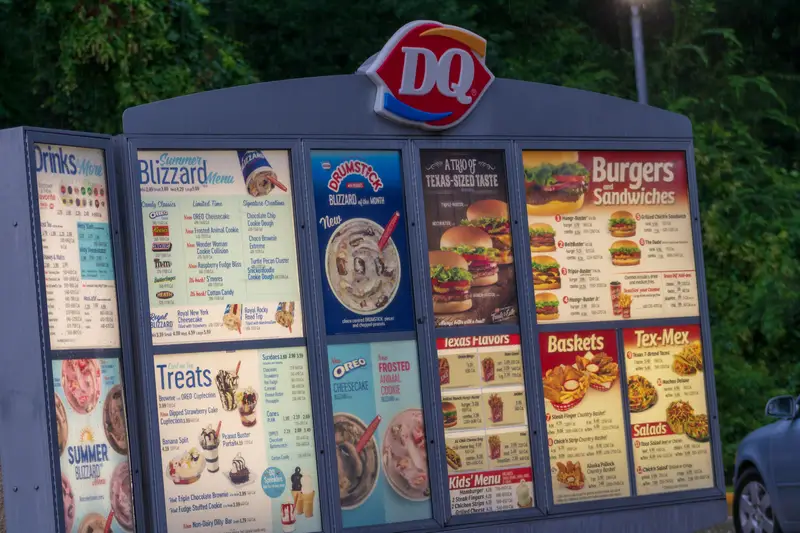
Pull up to a Dairy Queen this summer and the voice crackling out of the speaker box might not belong to a bored teenager on their third shift of the week. It might not belong to a person at all. Dairy Queen is rolling out AI voice ordering at its drive-thrus, and a lot of customers are not taking it well. The complaints started fast and got loud, and honestly, once you see how this thing works, it’s easy to understand why people are annoyed.
Here’s the short version. The company is swapping human order-takers for a robot voice at the speaker, and it’s doing it right as ice cream season kicks into gear. That timing is not an accident, and that’s part of what has folks fired up.
What Actually Changed at the Speaker Box
Dairy Queen announced in April 2026 that it had partnered with Presto, a San Mateo company, to run automated voice ordering. When you drive up and ask for a Blizzard and a basket of chicken strips, the bot listens, confirms your order on the screen, and fires it off to the kitchen. No human needed for most of it. The bot started in Dairy Queen’s own stores and is going out now to select franchisees in more than 25 states and Canadian provinces. Dairy Queen has more than 7,800 restaurants worldwide, so this is an early rollout rather than a finished one.
The company frames it as a win for everybody. Kevin Baartman, Dairy Queen’s EVP of IT, said the AI lets staff “focus on high-value tasks that ultimately benefit our Fans, with a friendly experience, and high order accuracy.” That is the company’s own wording, from its own press release. Translation: the person who used to talk to you at the speaker gets moved somewhere else, and a computer takes their spot. Whether that’s a win for you, the person sitting in the car, is a different question.
The Timing Is the Part That Stings
Dairy Queen didn’t quietly test this in the dead of January when the only people showing up are diehards. It launched the first phase during ice cream season, the busiest stretch of the year when the lines are longest and the parking lots are packed. That’s the exact moment a wrong order or an awkward pause costs the most.
The chain says its own testing improved both order accuracy and customer satisfaction, which is why it felt ready to push the button during peak season. That is Dairy Queen’s account of its own pilot, not an independent finding. But rolling out brand-new tech at your busiest time is a bold move, and if it flops, it flops in front of the maximum number of frustrated customers.
That 90 Percent Number Is Not What It Sounds Like
The figure that gets quoted is about 90 percent, and it is worth knowing what it counts. Presto advertises non-intervention rates: the share of orders the bot finishes without a restaurant worker stepping in. That is not the same as the share it gets right, and the SEC has already pulled the company up for blurring those two things. So the number tells you how often staff stay out of it, not how often your order lands correctly.
The complaints run the other way from the marketing. Plenty of customers describe repeating “no pickles” four times to a machine that keeps hearing “add pickles.” The percentages that get passed around for how often that happens trace back to a survey nobody names, so treat them as anecdote rather than measurement.
Here’s the Twist Nobody Saw Coming
This is the wild part. In December 2023, Bloomberg reported that Presto’s “automated” drive-thru orders were in large part being handled by human workers abroad, primarily in the Philippines and India. When the bot got tripped up by an accent, background noise, or a picky customization, a real person overseas would quietly step in. On the original version of the product a human was involved in every single order. On the later pilot version it was still about seven in ten.
So the shiny robot future was, for most of those orders, cheaper offshore labor with a computer voice slapped on top. In January 2025 the Securities and Exchange Commission settled charges with Presto Automation Inc. over misleading investors about how much of the work the AI was really doing. The company neither admitted nor denied the findings, agreed to a cease-and-desist order and paid no civil penalty. One thing needs keeping straight. Presto Automation was delisted from Nasdaq in 2024 and its assets were sold at a foreclosure auction. The business Dairy Queen signed with in 2026 is Presto Phoenix, Inc., a separate private company that bought those assets. The name carried over. The enforcement action belongs to the old one.
The Robot Was Built to Upsell You Every Time
Here’s a reason to keep your guard up. The AI isn’t just there to take your order. It’s designed to squeeze a little more money out of every car. Human employees upsell inconsistently. Some ask if you want to add a cookie, some don’t bother, some are too tired to care. The bot never gets tired. Presto advertises upsell offer rates of up to 88 percent, a consistency no shift can match.
For the chain, even a tiny bump in the average ticket size adds up fast across thousands of locations. That’s the real business case. It’s not really about you getting your Blizzard three seconds quicker. It’s about the machine gently nudging you toward the large every time you roll up. Presto teamed up with the voice company ElevenLabs in 2025 to make its bots sound more human, so the pitch lands softer.
Why People Are Actually Mad
Social media lit up the second word got out. The complaints are pretty down to earth. People don’t want to argue with a robot when they’re ordering a sundae. The gist is that people would rather talk to a person, plain and simple, and that staff end up taking over anyway.
The specific gripes are familiar to anyone who’s dealt with these systems. Robotic voices. Awkward silences where you’re not sure if the thing heard you. Machines that choke on a simple swap like trading onion rings for fries. Sean Thompson, head of IT at Freddy’s Frozen Custard, put the state of consumer-facing AI plainly: “we are still very much in an uncanny valley.” Almost human, and off enough to be annoying. And there’s a bigger reason the backlash hits harder here than at other chains. Dairy Queen built its whole reputation on small-town charm and friendly service. Swapping the friendly voice for a bot cuts against the brand’s entire personality.
Dairy Queen Is Far From the Only One
If this feels like a trend, that’s because it is. Presto works with about a dozen restaurant brands now, including Carl’s Jr., Hardee’s, Taco John’s, Wienerschnitzel, and Fazoli’s. Beyond Presto, Wendy’s, Taco Bell and Burger King are all live or testing voice ordering, though Taco Bell publicly slowed and reworked its rollout in 2025 after customer complaints. Culver’s and Zaxby’s often get lumped in, but what they installed is camera-based rather than voice. The automation is creeping into the kitchen too, with headset coaches and camera timers trimming service times.
The appeal for the companies is blunt. A bot doesn’t call in sick, doesn’t take breaks, doesn’t quit after two weeks, and upsells without fail. Presto added $10 million in January 2026, on top of the $18 million that funded the purchase of the old company’s assets, and its returning chief executive Krishna Gupta expects deployed AI to be everywhere in a couple of years. Investors clearly believe in it, even after some ugly public failures.
It Doesn’t Always Work Out
Worth remembering: the biggest name in fast food tried this and pulled the plug. McDonald’s ran an AI drive-thru program with IBM and switched it off in July 2024. Its stated reason was not that the tech had failed: the company said there was “an opportunity to explore voice ordering solutions more broadly,” and that IBM had given it confidence voice ordering would be part of its restaurants’ future. There were plenty of viral clips of the McDonald’s bot adding random items and racking up wrong totals. So the idea that AI ordering is a done deal is not quite true, and neither is the idea that the giants walked away from it.
A 2025 mystery-shopping study by Intouch Insight found AI lanes were faster than staffed ones and scored lower on friendliness, though overall satisfaction came out six points higher. Speed versus warmth. That’s the trade-off, and it’s the exact thing Dairy Queen fans are grumbling about.
What This Means for Your Next Blizzard Run
If your local Dairy Queen is one of the few dozen already running the bot, a few things are smart to keep in mind. Speak clearly and keep your order simple if you can. Check the screen while you order, because that’s where a mistake shows up first. And always double-check your total and your bag before you drive off, because the upsell is baked right in.
You can also just go inside and order at the counter, where an actual human is still standing there. Or hit the mobile app, which cuts the speaker out of the equation completely. For now, most Dairy Queens still have a person at the drive-thru, so the classic experience isn’t gone yet. But the direction is clear, and the customers making their frustration known are betting that loud complaints might slow the whole thing down. Whether that works is anyone’s guess. But if you like ordering your ice cream from a person who can actually laugh at your kid’s weird topping request, now’s a good time to say so.
