

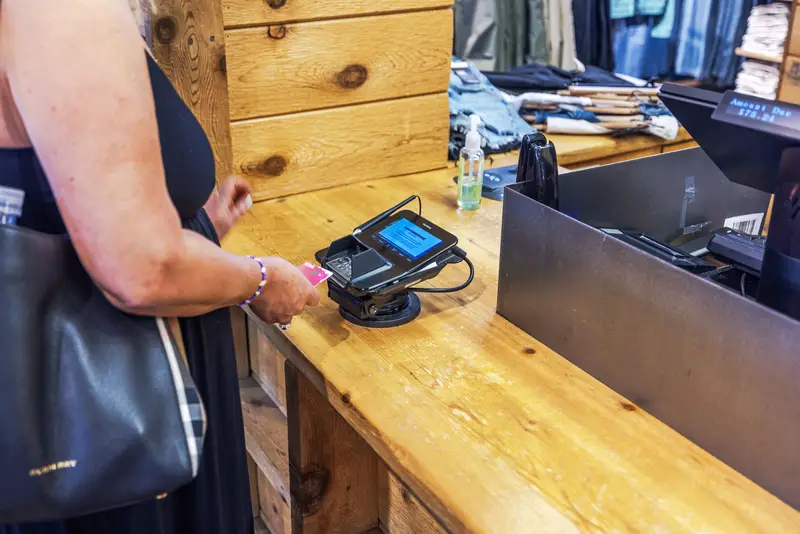
Adrianna Ceci walked into a Dollar Tree in Norwalk, Connecticut, and went to pay the way she always pays, by tapping her card. The man at the register told her tap was not working and she would need to insert it instead. Less than a day later, her bank called about charges she had not made.
Norwalk police later determined the checkout terminal had been tampered with. A skimmer had been placed over the real card reader, a plastic shell built to look exactly like the machine hiding underneath it, copying card data as it passed through. Officers found two devices at that store and a third at an ATM in the vestibule of a bank branch. Ceci did not lose money. Police said others may not be so lucky, and the investigation is ongoing.
The Fake Shell Goes On in Under Two Seconds
The Fayette County Sheriff’s Office in Georgia found overlay devices attached to registers at three different Dollar General stores after customers reported their card information was stolen. The overlays sit directly on top of the store’s own keypad. A customer swipes, the account details get saved on the hidden device, and the card keeps right on going into the real reader, so the sale rings up normally and nobody notices a thing. Investigators say the devices capture credit card numbers and EBT information. Similar equipment turned up on registers at Dollar General stores in Hogansville, Troup County and Harris County.
Fayette County authorities have not confirmed how long the gear was attached before it was found, and no suspect descriptions have been released.
Installation is faster than you would guess. During a Secret Service sweep of retailers in Los Angeles, surveillance video caught a suspect placing one over a payment terminal in less than two seconds. One device agents recovered blended in so well that it carried what looked like a security hologram. They had to pry it off. Inside were miniature electronics and a wireless transmitter, which means the person who planted it never has to come back for the data.
Give the Keypad a Soft Tug Before You Pay
Fayette County investigators tell shoppers to compare the terminal in front of them against the ones at the neighboring checkout lines. If one looks different from the rest, there is probably a reason. Watch for a terminal with unlit keypad lights while the machines beside it are fully lit, or plastic that looks thicker and stands up noticeably above the display screen. Then grab the side of the keypad and give it a soft downward tug. If anything comes loose, do not pull the unit the rest of the way off. Leave it and call 911.
State police Trooper Kalee Barnhart gives the same advice for ATMs and gas pumps, with a gentle tug and emphasis on gentle, plus a look for bulky keypads or stickers in strange places.
Other tells are smaller. A card slot that feels tighter than usual. A panel that appears to be made of a different material than the rest of the machine. A tiny hole near the keypad or the card reader. Store or manufacturer decals that are missing or look peeled off. That little hole matters, because the overlay is often paired with a pinhole camera pointed at the keypad, with a lens about the size of the tip of a ballpoint pen.
What the Secret Service Found When It Started Checking
In 2025, the Secret Service partnered with local law enforcement to visit 9,000 stores and check 60,000 gas pumps, point-of-sale terminals and ATMs. More than 400 illegal skimming devices came off machines during those operations.
The Los Angeles sweep gives a sense of the hit rate. Law enforcement visited 328 businesses, inspected 1,749 payment devices and seized 16 skimmers. The agency estimated those removals prevented about $16.6 million in potential fraud losses. Thirty-two active federal investigations currently span 15 states. A single skimmer, according to the Secret Service, can generate as much as $1 million in stolen funds. Across the country, skimming costs consumers and financial institutions more than $1 billion a year.
Store managers are often the last to know. “It has happened multiple times when a manager tells us they have checked their store. We ask if we can check. They give us the go-ahead, and we spot a skimmer right away,” said Michael Peck, assistant special agent in charge in the Secret Service’s Criminal Investigative Division, in a release issued by the agency.
Dollar Stores and Small Groceries Keep Turning Up
In South Florida, the Secret Service and the Homestead Police Department inspected payment terminals at several Dollar General and Dollar Tree locations along with smaller businesses such as Mexico Market. Surveillance video from Homestead and West Miami showed suspects using a silver pan to block employees’ view of the counter while allegedly tampering with terminals. That is the whole job: one person occupies the cashier, the other covers four seconds of work with a shopping bag or a tray.
Gold Valley Supermarket in Springfield, New Jersey, posted its own security footage to TikTok, where it drew more than 600,000 views within hours. The video appears to show a customer in a green shirt and a baseball cap taking an object from his pocket and setting it over the store’s card reader keypad while the cashier finishes ringing up groceries. The supermarket said it spotted the device within 20 minutes and pulled it before any other customer used that terminal with a chip card, and that it has notified police.
Stores with heavy EBT traffic get targeted on purpose. Many EBT transactions still require a magnetic-stripe swipe, which is exactly the data a skimmer is built to copy, and the U.S. Department of Agriculture’s Food and Nutrition Service says skimming-related EBT fraud is rising. The agency is working with states on moving those cards to chips.
Tap to Pay Is the Boring Answer That Works
Tapping beats inserting and inserting beats swiping, because a tap never puts your card in contact with a compromised reader. Phone wallets are stronger still. “They’ve not figured out how to steal information using Apple Pay or Google Pay,” Barnhart said. Tap-to-pay on the physical card adds a layer too.
When tap is not an option, keep the PIN off the keypad. Running a debit card as credit skips the PIN entry, which is the piece thieves need to pull cash out of an account rather than just buy things. If you do have to type it, cover the pad with your free hand. Police also suggest checking statements weekly instead of monthly, since the charges usually show up long before you would catch them at the end of a billing cycle.
Our take on the Norwalk detail: a register where tap suddenly stopped working, on a machine that worked fine last week, is a reason to pay cash or walk out. It is not a reason to insert your card.
If You Spot One, Keep Your Hands Off It
The instinct is to yank the thing off and hand it to a cashier. Don’t. Customers who pull skimmers off themselves sometimes break them in the process, and a damaged device can stop investigators from pulling forensic data off it. Handling one barehanded contaminates it and wipes out any usable fingerprints. Tell the manager, step away and call police.
An intact device is worth a lot to investigators. Barnhart said officers can use the data from a recovered skimmer to work out when it was placed, then pull the store’s video from that window and see who put it there. Working with the Secret Service, she said, that can lead to an arrest.
If your card information is already gone, call your issuer’s fraud department, kill the card and ask for a replacement with a new PIN. Norwalk police say the devices can grab the card number and the PIN in the same transaction, which is why the fraud alerts often land within hours.
Gas Pumps and ATMs Are Still the Other Half of This
Checkout overlays get the attention because you can see them, but the versions you cannot see are worse. Shimmers are thin devices slipped inside the card reader slot that read the chip on the front of your card. Skimmers pull from the magnetic stripe on the back. Both take seconds to install and seconds to remove, and thieves collect the haul over Bluetooth, off an SD card, or by coming back for the hardware. At gas stations, the device is often installed inside the pump itself, invisible from the outside, which is why some departments are now buying scanners and sweeping local businesses on request.
Targets shift. Colorado Springs police have seen fewer skimmers on regular gas pumps lately but an increase in business fuel cards being hit at diesel pumps, where spending limits run higher, with 15 cases in the city so far in 2026.
Thieves pick the easiest spots, meaning poorly lit machines and ones out of camera range, so an ATM inside a bank lobby is a better bet than a standalone box in a dark corner. Corpus Christi police list parking payment kiosks, vending machines and ride share or rental kiosks right alongside pumps and store registers. Five seconds of looking at the machine before you pay is the entire defense, and it is cheaper than the three weeks you will spend cleaning up after you skip it.
