

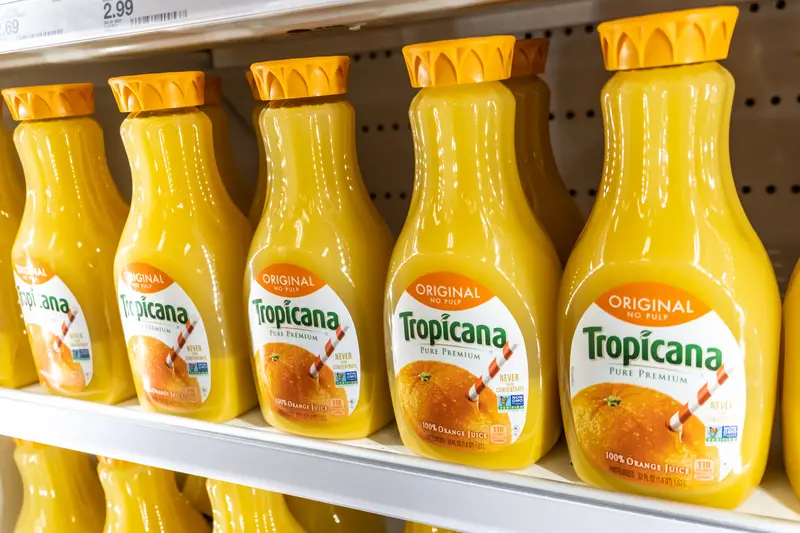
That carton of Tropicana orange juice sitting in your fridge right now isn’t exactly what it appears to be. While the label proudly displays “100% Pure Orange Juice” and “Not From Concentrate,” there’s a complex industrial process happening behind the scenes that most people never hear about. The orange juice industry has some surprising secrets that might change how you think about that morning glass of OJ.
Tropicana removes all the oxygen from their juice
When Tropicana processes their orange juice, they don’t just squeeze oranges and put the liquid straight into cartons. Instead, they store the freshly squeezed juice in massive tanks that can hold millions of gallons. To prevent spoilage during storage, they strip all the oxygen out of the juice through a process called deaeration. This allows the juice to sit in storage for up to a year without going bad.
Here’s where things get interesting: removing the oxygen also removes most of the natural orange taste. The deaerated juice becomes nearly flavorless, tasting nothing like the Tropicana orange juice that eventually makes it to store shelves. This creates a major problem for juice companies who need their product to actually taste like oranges when consumers drink it.
Flavor packs make every glass taste identical
Ever notice how every glass of Tropicana tastes exactly the same, whether you buy it in Florida or Alaska, in March or September? That’s not natural variation – that’s engineered consistency. Since the deaeration process strips away the natural orange taste, juice companies hire flavor and fragrance companies to create artificial “flavor packs” that get added back into the juice.
These are the same companies that create perfumes for brands like Dior and Calvin Klein. The flavor packs contain chemicals like ethyl butyrate, which mimics the taste of fresh orange juice but is completely artificial. Different brands use different flavor pack recipes, which explains why Tropicana always tastes different from Minute Maid, but each brand maintains its own consistent taste profile.
These flavor additives don’t appear on ingredient labels
Check your Tropicana carton right now, and you’ll see an incredibly short ingredient list. It probably just says “100% pure pasteurized orange juice” along with some added vitamins. What you won’t see listed anywhere are the flavor packs that give your juice its taste. This isn’t an oversight – it’s perfectly legal according to current labeling laws.
The reason these additives can stay hidden is because they’re technically derived from orange byproducts, even though they’ve been so heavily processed and chemically altered that they bear little resemblance to anything found in actual oranges. Since they originated from oranges, regulatory agencies don’t require companies to list them as separate ingredients, despite their artificial nature.
Tropicana has dominated the market since 1947
Tropicana wasn’t always the orange juice giant it is today. The company started in 1947 when Italian immigrant Anthony T. Rossi arrived in America with just $25 in his pocket. Rossi revolutionized the orange juice industry by developing better pasteurization methods and creating the famous “Juice Train” that transported orange juice across the country by railroad.
Today, Tropicana buys one-third of all oranges grown in Florida, making them the state’s biggest orange purchaser. The company now controls the largest share of the American orange juice market, which explains why their processing methods have become the industry standard that other brands follow.
Different countries get different flavor profiles
Tropicana doesn’t use the same flavor pack recipe worldwide. The company discovered that people in different countries prefer different orange juice tastes. Americans apparently like higher levels of ethyl butyrate, which gives a sweeter, more candy-like orange flavor. Mexicans and Brazilians prefer different chemical profiles in their orange juice.
Some companies even create flavor packs designed to mimic their competitors’ taste. This creates what industry insiders call a “hall of mirrors” effect, where artificial flavors are designed to copy other artificial flavors rather than actual oranges. Despite all these variations, most flavor packs try to recreate the taste of a Florida Valencia orange picked in spring.
Your juice might be over a year old
That “fresh” orange juice you bought yesterday could have been squeezed from oranges more than a year ago. The deaeration and storage process allows juice companies to keep their product in those massive tanks for extended periods. This helps them manage supply and demand throughout the year, since oranges are seasonal but people want to buy orange juice year-round.
The only time you can be relatively sure you’re drinking recently squeezed juice is during peak Florida Valencia orange season, which runs from March through June. The rest of the year, your Tropicana juice is likely a blend of stored Florida juice and imported juice from Brazil, where oranges grow during Florida’s off-season.
Not from concentrate doesn’t mean what you think
When Tropicana started marketing their juice as “Not From Concentrate” in the 1980s, sales doubled and profits nearly tripled within five years. Most people assumed this meant the juice was fresher and less processed than concentrate-based alternatives. In reality, the “not from concentrate” label mainly refers to the fact that water hasn’t been removed and then added back.
Both concentrate and non-concentrate juices go through extensive processing, including the deaeration and flavor pack additions. The main difference is storage method and cost – storing full-strength juice requires more expensive aseptic storage systems than storing concentrate. The “not from concentrate” juice isn’t necessarily closer to fresh-squeezed orange juice despite the higher price tag.
Tropicana hand-grades their oranges but processes them heavily
Before processing begins, Tropicana does take care to select quality oranges. The company claims to hand-grade all their fruit, removing any oranges that don’t meet their standards. The approved oranges get washed and “gently squeezed” to extract juice, while the peels are processed into orange oil that supposedly enhances the final product’s quality.
However, all this careful orange selection becomes somewhat meaningless once the juice enters the deaeration tanks. The processing methods strip away the natural flavors that made those hand-selected oranges special in the first place. The final product relies more on the artificial flavor packs than on the quality of the original fruit.
The sugar content rivals many sodas
One 8-ounce glass of Tropicana contains 22 grams of sugar – that’s nearly as much as a can of Coca-Cola. While Tropicana doesn’t add extra sugar beyond what’s naturally in oranges, the concentration of fruit sugars in juice form means you’re consuming far more sugar than you’d get from eating whole oranges. It takes multiple oranges to make a single glass of juice.
When you eat a whole orange, the fiber helps slow down sugar absorption and makes you feel full after one fruit. With juice, you can easily drink the equivalent of 4-6 oranges without feeling satisfied. The concentrated fructose hits your system much faster without the natural fiber that would normally regulate absorption.
Now that you know what’s really happening behind those bright orange cartons, you can make informed decisions about your morning drink. Whether you choose to stick with commercial orange juice or switch to fresh alternatives, at least you’ll understand exactly what you’re getting. Sometimes the most eye-opening discoveries come from looking closely at the everyday products we take for granted.
