

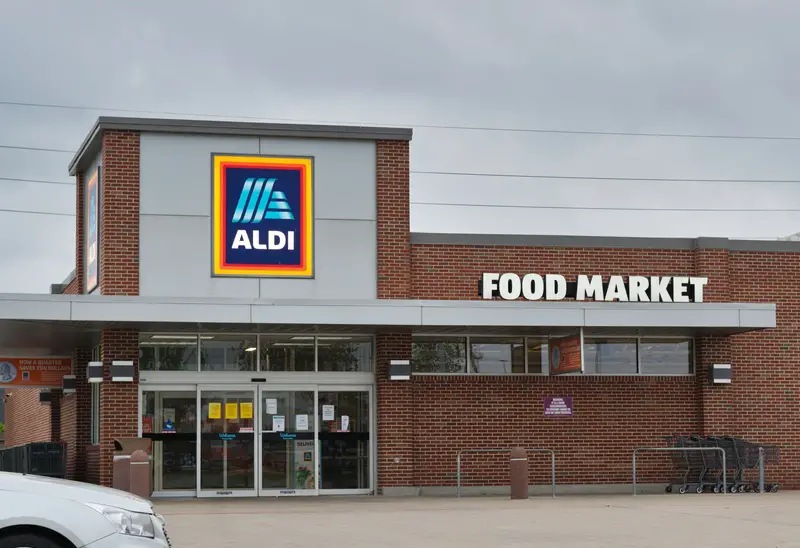
If you’ve been sleeping on Aldi, 2026 is the year that’s going to be hard to ignore. The German-born discount grocer — which has quietly become the third-largest grocery chain in America by store count, behind only Walmart and Kroger — is making moves that will change the way millions of Americans shop. We’re talking new stores, a total packaging overhaul, a brand-new website, and even a Times Square location. Yeah, that Times Square.
This isn’t a minor refresh. This is a company spending $9 billion over five years to fundamentally change how it shows up across the country. Here’s everything that’s actually happening.
180 New Stores In A Single Year
Aldi is opening more than 180 new stores in 2026, spread across 31 states. That will push the total store count to nearly 2,800 locations by year’s end. For context, Aldi currently operates more than 2,600 stores across 39 states and Washington, D.C. The company’s target? Hit 3,200 stores by the end of 2028.
These aren’t speculative numbers or press release fluff. The company opened about 120 new locations in 2024 and then followed that with over 225 store openings in 2025. The 2026 number represents a continuation of what’s already been the most aggressive grocery expansion in the country. CEO Atty McGrath, who stepped into the role in June 2025, said one in three U.S. households shopped at Aldi in 2025 — and 17 million new customers walked through Aldi doors that year alone.
Maine, Colorado, And The Push West
Aldi will enter Maine this year with a store in Portland, making it the chain’s 40th state. If you live in New England and thought Aldi was already everywhere, Maine was the holdout. Not anymore.
But the bigger story is out West. Aldi has announced plans to enter Colorado within the next five years, with more than 50 stores planned for the Denver and Colorado Springs markets. That expansion will be supported by a new distribution center in Aurora, projected to open in 2029. Phoenix is getting 10 new Aldi stores in 2026, with a plan to have 40 new stores in that metro by 2030. And Las Vegas, where Aldi debuted with four stores in 2025, will see its store count double by the end of the decade.
If you’re keeping score, Aldi is clearly treating the Western U.S. as its next frontier. The chain has long been strongest in the Midwest and East Coast, but the desert and mountain states are now firmly on the map.
The Southeast Takeover Is In Full Swing
Back in 2024, Aldi acquired Southeastern Grocers, the parent company of Winn-Dixie and Harveys Supermarket. That deal gave Aldi a pile of existing storefronts across the Southeast, and the company has been converting them into Aldi stores at a rapid clip. So far, nearly 90 of those former locations have been converted and reopened as Aldi stores.
In 2026, roughly 80 more will get the Aldi treatment, with plans to convert more than 200 total by the end of 2027. It’s a smart play — instead of building new stores from scratch, Aldi can gut and refit existing buildings. Faster, cheaper, and the parking lots are already there. For shoppers in Florida, Georgia, Alabama, and surrounding states, this means Aldi is about to be a lot more present in your daily life.
New Distribution Centers To Keep Shelves Stocked
You can’t open hundreds of stores without having the supply chain to back it up. Aldi has three new distribution centers in the pipeline: Baldwin, Florida (projected 2027), Goodyear, Arizona (projected 2028), and Aurora, Colorado (projected 2029). On top of that, the existing distribution center in Haines City, Florida, is being expanded to include a new chilled center specifically for perishable foods.
That Florida cold storage addition is directly tied to the Southeast expansion. As Aldi converts more Winn-Dixie and Harveys stores, it needs the refrigerated capacity to stock them with fresh produce, meat, cheese, and bread. An Aldi spokesperson mentioned favorites like Autumn Crisp grapes and exclusive Erandy Blackberries as the kind of fresh items they want to get into stores faster.
The Biggest Packaging Overhaul In Aldi History
Here’s where things get interesting for the regular Aldi shopper. If you’ve ever grabbed a box of Millville cereal or a bag of Clancy’s chips and wondered, “Is this an Aldi brand?” — the company is about to make that crystal clear. Around 90% of the items on Aldi’s shelves are private label, meaning Aldi owns and produces them. But for years, they’ve been sold under a confusing patchwork of brand names that most people didn’t realize were all the same company.
In 2026, that’s changing. The Aldi logo will appear on nearly everything the company makes. Some products will simply carry the Aldi name outright. Others — like the popular Specially Selected, Simply Nature, and Clancy’s lines — will keep their brand names but get a redesign with the words “An Aldi Original” printed on the packaging. It’s the largest packaging refresh in the company’s 50-year U.S. history.
The rollout actually started in late 2025 with a few products — some deli meats, cheese slices, guacamole, and potato salad showed up with the new branding. But 2026 is when it goes wide.
“Red Bag Chicken” Is Now Its Actual Name
This one is genuinely fun. If you’ve spent any time in Aldi forums, Facebook groups, or subreddits, you know that the Kirkwood Breaded Chicken Breast Fillets have been called “Red Bag Chicken” by fans for years. It’s one of the most talked-about items in the store. Well, Aldi is officially renaming the product to Red Bag Chicken.
An Aldi representative said the move is meant to show how much the company values its customers. Whether you see it as a cute marketing stunt or a genuine nod to the community, it’s the kind of thing that makes people feel like the brand is actually paying attention. And in an era where most grocery stores feel like faceless corporations, that counts for something.
A Times Square Aldi — No, Seriously
Aldi is opening a store in New York City’s Times Square in 2026. The location will be inside The Ellery, a new luxury residential building at 312 West 42nd Street. At 25,000 square feet, this store will be about double the size of a typical Aldi.
A discount grocer in one of the most expensive retail corridors on Earth? It sounds like a contradiction, but it’s actually a brilliant flex. Nothing says “we’ve arrived” quite like a store address next to the M&M’s store and a hundred Broadway theaters. Whether tourists will actually grocery shop there is another question, but for brand awareness, you can’t buy better real estate.
A Completely Redesigned Website
Aldi’s current website is… fine. It works. But the company is launching a completely redesigned version early in 2026, and it’s focused on making online shopping and trip planning much easier. The new site will include tailored product recommendations for easy reordering, expanded nutritional information, shoppable recipes, and built-in meal planning tools.
Curbside pickup will also be smoother, and home delivery will be available through partnerships with Instacart, DoorDash, and Uber Eats. For a store that built its reputation on the no-frills, grab-a-quarter-for-your-cart in-store experience, this is a real shift toward meeting the online-first grocery shopper where they are.
Sustainability Goals Are Quietly Moving Forward
Aldi is also working toward fully recyclable packaging on its private-label products. The company aims to use 30% more recycled material in its plastic content in 2026 and is updating packaging labels to make recycling instructions easier to follow. There’s also a push for more supply chain transparency, specifically around coffee and seafood sourcing, though it’s not yet clear how that will show up on actual packaging or in stores.
Why This Matters For Your Grocery Bill
Here’s the real takeaway. According to data from Placer.ai, Aldi’s store traffic grew 8% year over year in 2025. Compare that to Costco at 5.9%, Albertsons at 1.6%, Kroger at 0.8%, and Walmart at 0.5%. The overall grocery sector only grew 3.1%. People aren’t just curious about Aldi — they’re switching.
CEO McGrath put it plainly: shoppers aren’t looking for fancy stores and tens of thousands of items to choose from. They want to save money without sacrificing quality, and they want to get in and out fast. Aldi’s model — small stores, limited selection, mostly private-label products — was designed for exactly this moment. And with a $9 billion investment behind it, the company is betting that this moment isn’t going away anytime soon.
Whether you’re a die-hard Aldi fan who knows the Aisle of Shame by heart or someone who’s never stepped inside one, 2026 is shaping up to be the year Aldi stops being the “quirky budget store” and starts being just… the store. Get ready to see a lot more of that blue and orange logo.
