

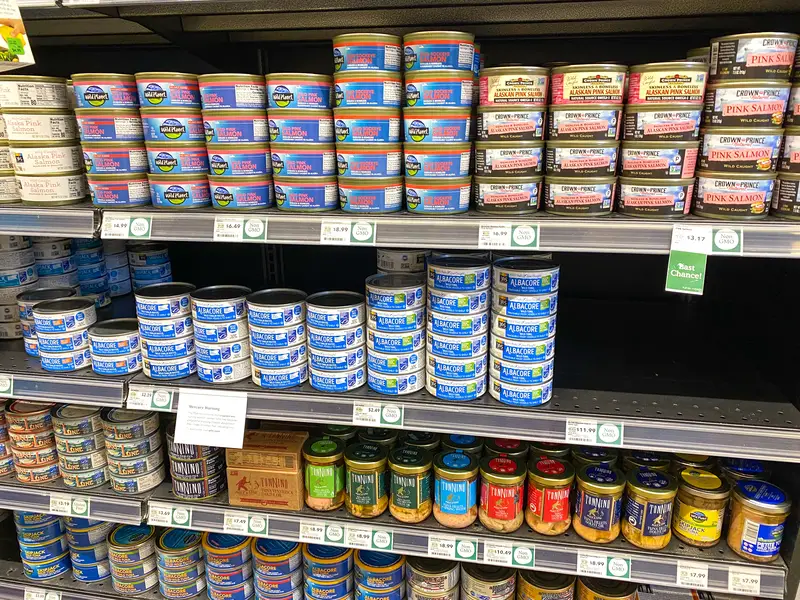
You’re standing in the canned goods aisle, staring at a wall of tuna. StarKist, Bumble Bee, Chicken of the Sea, maybe some fancy brand you’ve never tried. They all look roughly the same — metal cans, pictures of fish, maybe a little wave graphic. You grab the cheapest one and toss it in the cart. Done.
Except here’s the thing: those labels are actually telling you a lot, and most of us never bother to read them. The difference between one can and another can come down to mercury levels, how the fish was caught, what species is inside, and whether the tuna was packed in a way that actually tastes good or just passes for edible. A couple of seconds of reading could change what ends up on your plate — and in your body.
Here’s what the people who actually pay attention are looking for.
The Catch Method Tells You More Than You Think
Flip a can of tuna around and look for words like “pole-caught,” “pole-and-line-caught,” or “troll-caught.” These aren’t marketing buzzwords — they describe exactly how the fish was pulled out of the ocean. And it matters more than you’d guess.
Pole-and-line fishing is exactly what it sounds like: one pole, one line, one fish at a time. It’s selective. Fishermen catch the tuna they’re targeting and leave everything else alone. Compare that to purse seine nets, which scoop up everything in a massive area — tuna, dolphins, sea turtles, sharks, juvenile fish that haven’t had a chance to reproduce. The bycatch problem with large-scale netting is enormous.
Trawling is another method you’ll see listed, and while some trawl methods are considered acceptable, the general rule is: the more targeted the catch method, the better. If a can doesn’t mention how the fish was caught at all, that silence is telling you something. Companies that use responsible methods want you to know about it. The ones that don’t? They’d rather you didn’t ask.
FAD-Free Is a Phrase Worth Knowing
FAD stands for Fish Aggregating Device. These are floating objects — sometimes as simple as a log or a buoy — that attract marine life in the open ocean. Fish gather around them naturally, and then fishing boats come through and net everything clustered there. The problem is that FADs don’t just attract tuna. They attract anything that swims, including endangered species.
When a label says “FAD-free” or “free school,” it means the tuna were caught swimming freely in open water, not lured to a device first. Free school or school-caught tuna tends to have lower rates of bycatch because the fishermen are targeting a specific group of tuna they can see, rather than blindly netting whatever gathered around a floating object.
Not every brand puts this on their label. But the ones that do are usually the ones you want to buy.
Mercury Levels Vary Wildly Between Species
This is where things get personal, especially if you eat tuna regularly or feed it to kids. Not all canned tuna carries the same mercury risk, and the species inside the can makes a big difference.
Albacore tuna — the white tuna you see on shelves — is a larger fish that lives longer and eats higher on the food chain. That means it accumulates more mercury over its lifetime. The FDA recommends limiting albacore to about one serving per week for adults. For kids, it’s less.
Skipjack tuna — typically labeled as “chunk light” — is a smaller, shorter-lived species. It has roughly three times less mercury than albacore. If you’re someone who eats tuna several times a week (meal preppers, I’m looking at you), skipjack is the safer bet by a wide margin.
Yellowfin tuna falls somewhere in the middle. You’ll see it in some premium cans and pouches. It’s got more mercury than skipjack but less than albacore. The label should tell you which species is inside — if it doesn’t, that’s another red flag.
Some Brands Actually Test Every Single Fish
Here’s a detail that surprised me: most tuna companies don’t test every fish for mercury. They do batch testing or periodic testing, which means some individual fish with high mercury levels can slip through. For a lot of people, that’s fine — the averages work out. But if you’re pregnant, nursing, or feeding small children, the averages are cold comfort.
A handful of brands have started testing every single fish before it goes into a can. Safe Catch is probably the most well-known example — they set mercury limits that are stricter than the FDA’s action level and reject any fish that doesn’t pass. You’ll pay more for it (usually $3-5 per can versus $1-2 for mainstream brands), but for certain people, that tradeoff makes sense.
Look for specific mercury testing claims on the label, not just vague “quality tested” language. There’s a difference between testing for contaminants and actually setting a mercury threshold that individual fish have to clear.
The Blue MSC Label Actually Means Something
You’ve probably seen little certification logos on food packaging and ignored them. Fair enough — most of them are meaningless or self-awarded. But the blue MSC label (Marine Stewardship Council) on tuna cans is one of the few that actually carries weight.
The MSC is an independent organization that certifies fisheries based on three criteria: whether fish populations are healthy and sustainable, whether the fishing operation minimizes environmental impact, and whether the fishery is well-managed with real accountability. Getting certified isn’t easy — it involves years of assessment and ongoing audits. The MSC logo is generally considered the gold standard for seafood sustainability.
Is it perfect? No. Critics point out that the certification process is expensive and can shut out small-scale fisheries that are actually more sustainable than large operations. But as a quick grocery-aisle shorthand, it’s the best tool available to the average shopper.
Oil-Packed vs. Water-Packed Changes Everything
This one’s partly about taste and partly about nutrition, and people have strong opinions about it. Tuna packed in oil — usually olive oil or soybean oil — tends to be richer, more flavorful, and has a better texture. Italian and Spanish brands almost exclusively use olive oil, and there’s a reason: it tastes dramatically better.
Water-packed tuna is leaner and lower in calories, which is why it dominates the American market. But here’s what a lot of people don’t realize: when you drain water-packed tuna, you lose a chunk of the omega-3 fatty acids along with the liquid. The healthy fats are water-soluble, so they end up going down the drain. Oil-packed tuna retains more of those omega-3s because they stay dissolved in the oil.
If you’re eating tuna for the protein and nothing else, water-packed is fine. But if you want it to actually taste like food rather than a punishment, consider oil-packed — especially extra virgin olive oil. Your sandwiches will thank you.
Solid vs. Chunk vs. Flake Isn’t Just Marketing
These terms are regulated by the FDA, so they actually mean specific things. “Solid” or “solid pack” tuna is a single large piece of loin — it holds together when you take it out of the can. “Chunk” is smaller pieces that are still identifiable. “Flake” is basically broken-up bits, often from the parts of the fish that didn’t make the cut for solid or chunk.
You pay more for solid pack, and it does have a better texture for things like tuna steaks, niçoise salads, or eating straight from the can with a fork. But for tuna salad or casseroles where you’re mixing it with mayo and celery anyway? Chunk works perfectly, and you’ll save a dollar or more per can.
Flake-style tuna is what you often find in the absolute cheapest cans. It’s fine for cooking but doesn’t look or feel great on its own. Knowing this distinction helps you match what you’re buying to how you’re actually going to use it, instead of overpaying for premium cuts that are about to get smashed into a sandwich.
Country of Origin and Where It Was Processed
This is one of the sneakier label details. A can might say “Product of Thailand” or “Packed in Ecuador” — that doesn’t necessarily tell you where the fish was caught. Tuna can be caught in one ocean, frozen, shipped to another country for processing and canning, and then shipped again to the U.S. for sale. That’s a lot of miles on a fish.
Some labels will specify where the tuna was caught: “Caught in the Western Pacific” or “Atlantic-caught.” Others will specify that the fish was caught and packed in the same country, which usually means less handling and a fresher product in the can.
American-caught and processed tuna exists, though it’s a smaller slice of the market. Brands like Wild Planet and American Tuna source from U.S. fisheries and can domestically. You’ll pay a premium, but you also get more traceability — you can often trace the fish back to a specific boat and fishing trip.
Added Ingredients You Didn’t Ask For
Flip to the ingredient list and you might be surprised at what else is in there. Some canned tuna contains added soy broth, vegetable broth, pyrophosphate (a texture modifier), and hydrolyzed protein. None of these are dangerous, but they’re worth knowing about — especially if you have soy allergies or are trying to eat clean.
The simplest cans list two or three ingredients: tuna, water (or oil), and salt. Some don’t even include salt, leaving that up to you. If the ingredient list is longer than a couple of lines on a tuna can, something extra got added that didn’t need to be there.
None of this means you need to spend 20 minutes in the tuna aisle cross-referencing labels. But spending 20 seconds — enough time to check the species, the catch method, and whether there’s an MSC certification — puts you ahead of about 95% of shoppers. And when you’re eating something two or three times a week, those small differences add up fast.
