

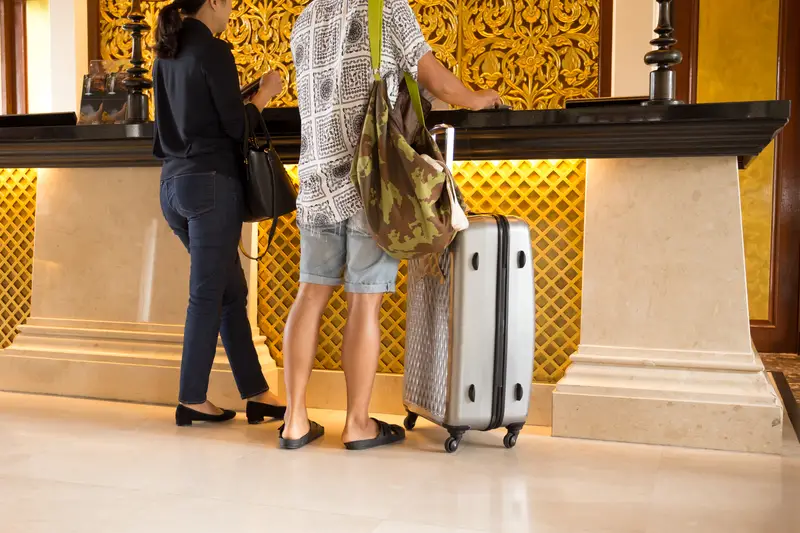
You walk up to the hotel front desk after a long flight. The clerk glances at your ID, swipes your credit card, slides a plastic key card across the counter, and then spins a little screen around so it faces you. There it is. A tip prompt. For handing you a key.
If you have felt that awkward pause where you are staring at 15%, 20%, and 25% buttons wondering if you are a bad person for hitting “no tip,” I have good news. You are not a bad person. You are one of the last sane people in America. This is the one hotel worker where tipping is genuinely money down the drain, and I want to explain exactly why before you ever tap that screen again.
The One Person You Can Stop Tipping Right Now
The front desk clerk is the answer. Travel watchers have started spotting QR codes and tip prompts popping up at check-in counters across the country. Between December 2024 and May 2025, a Marriott property in Bryan, Texas, the Hyatt Centric Faneuil Hall in Boston, and a Fairfield Inn in Midtown Manhattan were all photographed asking guests for tips just for checking them in. Not for carrying bags. Not for fixing a problem. For the bare minimum: looking at your ID, running your card, and giving you a key.
One frequent traveler put it bluntly, telling readers that if you see one of these signs asking you to tip the front desk, please do not do it. And here is the kicker: with those QR codes, the employee probably does not even know right away that you paid. So you are not making anyone’s day. You are throwing a few bucks into a system that barely acknowledges it happened.
Why Hotels Suddenly Want You To Do This
This did not happen by accident. Staff cost money, and hotel owners are always looking for ways to trim that cost. One easy trick is to nudge the price of employees off their own books and onto you, the guest, through tips. Every dollar you hand a front desk worker is a dollar the owner did not have to build into that person’s paycheck.
That is what people mean when they talk about “tip creep.” It is the slow spread of tipping into spots where it never used to exist. This is not the tip jar at your coffee shop. This is a front desk job, hourly work at a median of about fourteen dollars an hour, quietly turning into a tipped one without anyone asking your permission. It is a good scam for the business and a bad deal for you. The same logic shows up all over the hotel, and once you see it, you cannot unsee it.
What The Etiquette Experts Actually Say
You might think the manners crowd would tell you to tip everyone in sight. They do not. Elaine Swann, who founded the Swann School of Protocol, told CNBC in 2024 that counter workers, meaning the people who do not bring food or service to you, are not owed a tip. She was talking about coffee counters and checkout screens generally rather than hotels, and she was clear that it is your discretion rather than a rule. She nailed the reason it feels so uncomfortable too. “When they turn that device around, it’s this glaring thing, and people feel shamed into tipping, but you don’t have to,” she said.
That shame is the whole play. The screen is designed to make you sweat in front of a stranger. For front desk staff doing a routine check-in, no tip is required, unless they went way out of their way to solve a real problem for you. Asking the concierge a quick question or getting directions to a restaurant does not require payment either.
The same goes for asking where the nearest attraction is. The experts are not being cheap. They are telling you the front desk was never a tipping job, and pretending it is now only helps the owner.
You Are Already Paying For This
Here is the part that really should make your blood pressure spike. You are probably already handing the hotel extra money before you ever meet the front desk person. NerdWallet looked at 160 hotels and found that among the 30 of them charging a resort fee at all, the average was about $33 a day. These are mandatory. They get tacked onto the advertised room rate under names like “destination fee” or “amenity fee,” and they are especially brutal in Las Vegas, Hawaii, and New York, where they tend to get branded destination fees instead.
Since May 12, 2025, an FTC rule has required hotels and booking platforms to show you the full price upfront instead of springing these charges on you at the end. The rule does not kill the fees, though. It just makes them visible. So think about the math. You are already paying $33 a night in mandatory charges that supposedly cover the hotel’s operations and amenities. Tipping the front desk on top of that is paying twice for the same thing. It is a double dip, and you are the one getting dipped.
The Person Who Actually Deserves It
Now, before you decide to stop tipping every single person in the building, let me be fair. There is one hotel worker who is doing real, physical, personal work for you, and that is housekeeping. These are folks earning a median of about $34,920 a year, going by the Bureau of Labor Statistics figures for hotel housekeepers as of May 2025, and they are some of the least tipped people in the whole hotel, which means they tend to be the most grateful when someone actually leaves something.
But even here, most people do it wrong and waste the money anyway. The classic mistake is leaving one lump sum at checkout. The problem? The same housekeeper does not clean your room every day. Different staff fill in on days off. So if you tip $25 at the end of a five night stay, that money might go entirely to the person who cleaned on checkout morning, while the person who cleaned the other four nights gets nothing at all. You meant well and still missed the target.
It gets messier. One traveler’s account, and it is one account, describes a housekeeper saying supervisors sometimes swipe cash left on desks or pillows, and thanking the guest for finding her in person to hand it over. So even the tip you leave in good faith is not guaranteed to land where you think. The system is a mess, and a lot of guests have simply given up. Surveys put the share of guests who always tip housekeeping at around a quarter,
How To Tip Without Throwing Money Away
If you do want to leave something for housekeeping, and I think it is a decent thing to do, do it in a way that actually works. Tip every day, not at the end. Leave $2 to $5 in cash each morning so it reaches whoever actually cleaned that day. Put it in an envelope or under a note that clearly says it is a tip, and set it somewhere obvious like near the pillow, so nobody mistakes it for money you left lying around. One frequent traveler says daily tipping really does get noticed, precisely because these workers are so rarely tipped at all.
And know when the answer is just no. If a bill already carries an 18% to 20% service charge, ask where it actually goes. Etiquette experts say that when a venue applies that charge and tells you it reaches the staff, you are not on the hook to add more. If it goes to the house, which happens more often than you would think and has been fought over in court in Hawaii, New York and California, tip anyway. Thomas Farley, the etiquette writer who goes by Mister Manners, described getting hit with 20% on top of an existing 20% at a restaurant in Denver and walking away feeling like the whole thing had gone off the rails. Same idea at many all inclusive resorts, where gratuities are baked into the package. Check before you pay twice.
The Verdict
The clear loser here is the front desk clerk tip. Not because the person behind the counter is not nice or hard working, but because checking you in was never a tipped job, and turning it into one only helps the owner shave a little more off their payroll while you foot the bill. You are already paying a room rate. You are probably already paying a $33 resort fee. You do not owe an extra few dollars for a swipe and a key card.
So the next time that screen spins around at check-in, take a breath and tap the button that says no. Save your cash for the housekeeper who scrubbed your bathroom, leave it daily, and leave it in a way that actually reaches a human being. That is where a tip does something. The front desk screen is just a slot machine that only pays out for the house. Do not feed it.
