

I want you to think about the last time you paid two bucks for a bottle of water at a gas station. You were thirsty, maybe a little dehydrated, and you grabbed something with a clean-looking label — maybe a mountain on it, maybe some blue swoosh that vaguely suggested purity. You twisted off the cap, took a sip, and felt like you’d made a reasonable decision.
Here’s the thing: there’s a very good chance that water came from the same municipal source that feeds your kitchen sink. Not a pristine alpine spring. Not a deep underground aquifer untouched by civilization. A treatment plant. The same one your neighbors use to fill their dog’s bowl.
And you’re far from alone. According to research on bottled water sourcing, nearly 64% of bottled water sold in America is sourced from municipal tap water. That’s not some fringe claim from a conspiracy blog — that’s the actual breakdown of what’s inside most of those bottles sitting in your fridge right now.
So let’s get into which brands are doing this, how they get away with it, and whether any of it actually matters.
Aquafina: PepsiCo’s Very Expensive Tap Water
Aquafina is probably the most well-known offender on this list. It’s owned by PepsiCo, one of the largest beverage companies on Earth, and it’s sold in practically every convenience store, airport, and vending machine across the country. For years, people assumed Aquafina came from some special source. It doesn’t.
Aquafina uses purified municipal water — tap water that’s been run through a filtration process called reverse osmosis. PepsiCo was actually forced to change Aquafina’s labeling back in 2007 after pressure from advocacy groups. They now include the phrase “purified drinking water” on the label, along with fine print noting the source is public water. But how many people actually read the fine print on a water bottle? Almost nobody.
Aquafina typically runs between $1.50 and $2.50 for a single 20-ounce bottle, depending on where you buy it. Your tap water at home costs a fraction of a penny per gallon. That math is brutal.
Dasani: Coca-Cola’s Version of the Same Thing
If PepsiCo is selling filtered tap water, you better believe Coca-Cola is too. Dasani is Coke’s bottled water brand, and it’s sourced from local municipal water supplies just like Aquafina. The water gets filtered, and then Coca-Cola adds back a proprietary blend of minerals — magnesium sulfate, potassium chloride, and salt — to give it a specific taste profile.
That mineral blend is actually why some people say Dasani tastes a little “off” or slightly salty compared to other bottled waters. It’s not your imagination. They’re literally adding stuff back into the water after stripping it clean. Whether that makes it better or worse is a matter of personal preference, but the point remains: the base product started as tap water from municipal sources.
Dasani is everywhere. It’s the default water at most McDonald’s locations, at movie theaters, at Walmart checkout lines. Americans buy billions of these bottles every year without really thinking about where the water comes from.
Nestlé Pure Life: “Purified” Is Doing a Lot of Heavy Lifting
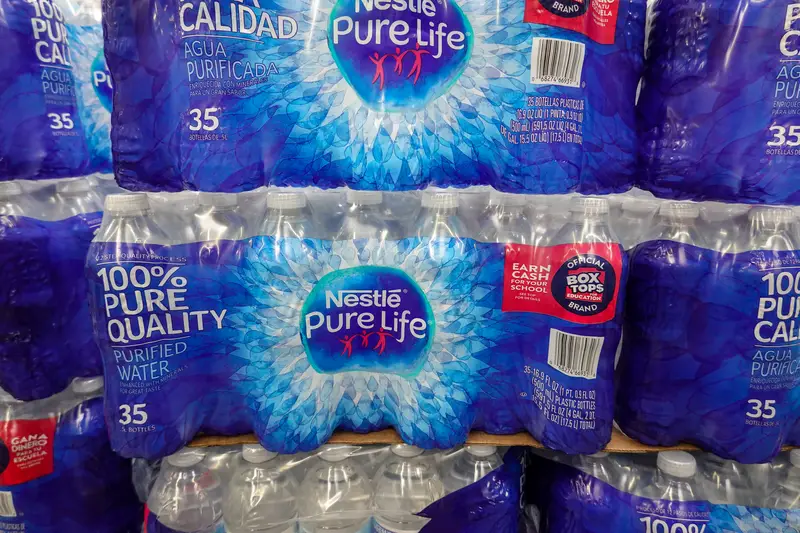
Nestlé Pure Life (now owned by BlueTriton Brands after Nestlé sold off its North American water business in 2021) has long been one of the best-selling bottled water brands in the country. It’s cheap, it’s available at every grocery store, and the branding makes it look wholesome.
But Pure Life sources its water from both wells and municipal supplies, depending on the bottling location. That means some of what you’re drinking might come from a well, and some of it is straight-up filtered tap water with added minerals. The label says “purified water enhanced with minerals for taste,” which is technically accurate but wildly misleading if you’re picturing mountain streams.
Pure Life is one of the cheapest options out there — you can grab a 24-pack at most stores for around $4 to $5. At that price, you’re not exactly getting ripped off in the traditional sense. But you’re still paying for something that came out of a pipe and went through a filter, which is what a $30 Brita pitcher does at home.
Kirkland Signature (Costco): Tap Water in Bulk
Costco’s house brand water — Kirkland Signature — is produced by Niagara Bottling LLC, one of the largest private-label bottled water companies in the U.S. And Niagara uses tap water as a primary source for many of its products.
Now, Costco shoppers love Kirkland water because it’s insanely cheap. A 40-pack of 16.9-ounce bottles goes for around $4 to $6, which works out to something like 12 to 15 cents per bottle. That’s hard to argue with from a cost perspective. But you should know what you’re buying. This isn’t spring water. This isn’t glacier water. It’s municipal water that’s been purified and bottled in massive quantities.
Niagara Bottling also produces water for several other store brands, so if you’re buying generic bottled water from other retailers, there’s a decent chance it came from the same facilities.
Sam’s Choice and Acadia: The Ones That Raised Red Flags
Walmart’s Sam’s Choice and Giant Food’s Acadia brands deserve special mention — and not in a good way. Both were called out in testing for having high levels of contamination, including disinfection byproducts. Sam’s Choice in particular was flagged for contamination levels that exceeded certain standards, which is ironic for a product people buy because they assume it’s cleaner than what comes out of their faucet.
This is the real problem with the “purified tap water” business model. When companies source from municipal supplies and then run the water through their own filtration, the assumption is that the end product is at least as clean as what you’d get at home. But testing has shown that’s not always the case. Some bottled water actually tests worse than the tap water in many American cities.
It’s a weird situation: you go to Walmart, you spend money on bottled water because you want something clean, and you might end up with water that’s less pure than what your city already provides for free.
How to Tell From the Label
Here’s a quick trick that works almost every time. Look at the label on your bottled water. If it says “purified water” or “purified drinking water,” it almost certainly came from a municipal tap water source. The company pulled it from a public supply, ran it through reverse osmosis or distillation, maybe added some minerals, and bottled it.
If the label says “spring water,” the water is legally required to come from a natural spring — an underground source where water flows to the surface on its own. Brands like Poland Spring, Evian, and Fiji fall into this category. That doesn’t automatically make them better, but it does mean they’re not repackaging your city’s water supply.
“Mineral water” is another category, and it means the water has naturally occurring minerals from its underground source. “Artesian water” means it came from a confined aquifer. These designations are regulated by the FDA, so companies can’t just slap them on any label.
The word “purified” is the giveaway. It sounds premium, but it really just means “we cleaned up tap water.”
Why Companies Do This (and Why It’s Legal)
There’s no law against selling filtered tap water in a bottle. The FDA regulates bottled water as a packaged food product, and as long as companies meet purity standards and label their products accurately, they’re in the clear. And “purified water” is an accurate description — they did purify it. They just started with the same stuff that flows through your pipes.
The reason so many companies use municipal sources is simple: it’s cheap and consistent. Tap water is already treated to meet EPA standards before it even reaches the bottling plant. That gives companies a head start. They filter it further, bottle it, and mark it up by several thousand percent. The profit margins on bottled water are staggering compared to almost any other packaged beverage.
A gallon of tap water in most American cities costs less than a penny. A gallon of bottled water costs between $1 and $8, depending on the brand. You’re not paying for the water. You’re paying for the plastic, the label, the transportation, and the marketing.
So Should You Stop Buying Bottled Water?
That depends on your situation. If you live somewhere with genuinely bad tap water — and yes, those places exist in America, as Flint, Michigan painfully demonstrated — bottled water might be a necessity. If your home has old lead pipes or your local water utility has a history of violations, buying bottled makes sense as a short-term fix.
But if you live in a city with clean, well-maintained water infrastructure (which is most of the country), you’re buying a convenience product. Nothing more. A reusable bottle and a basic filter at home will give you the same thing — or better — for a tiny fraction of the cost.
The bottled water industry pulls in over $24 billion a year in the U.S. alone. A huge chunk of that revenue comes from selling people their own tap water in a plastic bottle with a pretty label. Once you know that, it’s hard to look at that cooler in the gas station the same way again.
Next time you reach for a bottle, just flip it around and read the fine print. If it says “purified,” you already know the story.
