

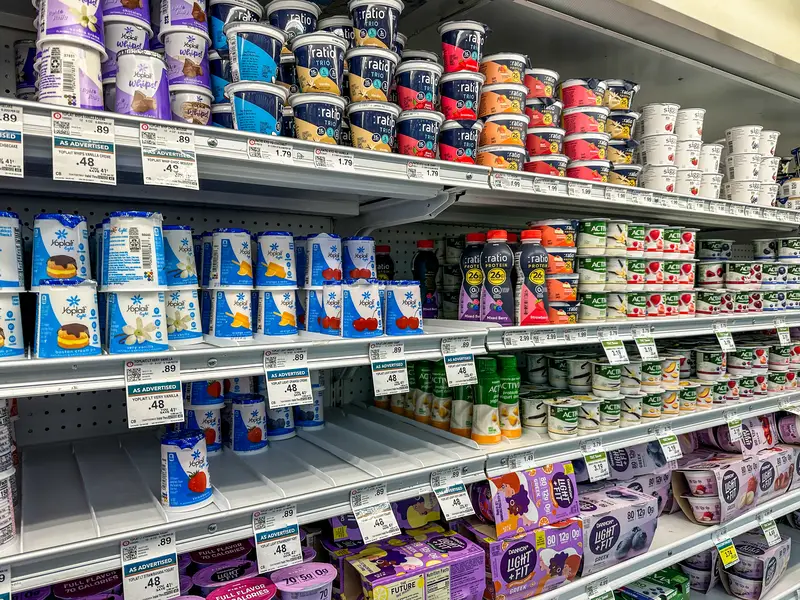
You’re standing in the dairy aisle, trying to make a decent choice. You grab a yogurt because it says something like “light” or “protein” or “Greek” on the label, and you feel good about yourself. You shouldn’t. A shocking number of yogurt brands on American shelves are basically dessert pretending to be health food. Some have more sugar than a Snickers bar. Others are loaded with thickeners, artificial sweeteners, and ingredients you’d need a chemistry degree to pronounce. I spent way too long reading nutrition labels and consumer complaints so you don’t have to. Here are the brands that deserve to stay on the shelf.
Yoplait Original French Vanilla
Yoplait is the yogurt your mom packed in your lunchbox in 2003, and honestly, it should have stayed there. A single 6-ounce container of Yoplait Original French Vanilla packs around 18 grams of sugar. That’s nearly five teaspoons. For context, the American Heart Association says women should cap added sugar at about six teaspoons per day and men at nine. One little cup of Yoplait eats up most of that allowance before you’ve even had lunch.
The ingredient list tells the story. After milk and sugar, you’ll find corn starch, modified corn starch, and kosher gelatin. This is less yogurt and more of a vanilla-flavored pudding with a marketing team. Yoplait has been leaning on brand recognition for decades, but the product itself hasn’t kept up with what people actually want from yogurt in 2024. If you’re eating it because it tastes good, fine — but don’t pretend it’s a health food.
Yoplait Light Strawberry
“But wait,” you say. “I buy the Light version.” That’s arguably worse. Yoplait Light Strawberry swaps out real sugar and replaces it with sucralose — the same artificial sweetener in Splenda. You drop from 18 grams of sugar to about 9, which sounds great until you realize you’re now consuming a zero-calorie sweetener that research has repeatedly linked to disrupted gut bacteria. For a product that’s supposed to contain live cultures that help your gut, that’s an odd strategy.
It also still has modified corn starch, carrageenan, and artificial color. You’re saving about 70 calories compared to the Original, but you’re trading real ingredients for a lab experiment. If your goal is fewer calories, just eat a smaller portion of something that’s actually food.
YoCrunch Low Fat Vanilla With M&M’s
This one barely qualifies as yogurt. YoCrunch takes low-fat vanilla yogurt and pairs it with a side compartment of M&M’s, because apparently we’ve given up as a society. A single container has around 29 grams of sugar and reads more like a candy bar nutrition panel than a dairy product. The “low fat” label is doing a lot of heavy lifting here, distracting you from the fact that you’re eating chocolate candy for breakfast and calling it healthy.
YoCrunch makes several varieties with toppings like Oreo pieces, Reese’s Pieces, and cookie dough. Every single one is a sugar bomb. Kids love them, which is exactly the problem — they’re marketed in a way that makes parents think they’re packing something nutritious in a lunch bag. They’re not. It’s ice cream without the freezer.
Activia Greek Vanilla
Activia built its entire brand around gut health. Jamie Lee Curtis did those commercials for years. The problem? Activia Greek Vanilla has about 16 grams of sugar per serving, and the probiotic benefit they advertise is marginal at best. The specific strain they use — Bifidus regularis — is Activia’s own trademarked name for Bifidobacterium animalis lactis DN-173 010. Studies on it have shown mixed results, and the Federal Trade Commission actually hit Dannon (Activia’s parent company) with a $21 million settlement back in 2010 for exaggerating the health benefits.
You’re paying a premium for a yogurt that has more sugar than many competitors, a probiotic claim that’s been legally challenged, and a brand name that still coasts on decade-old TV spots. Plain Greek yogurt from a store brand will give you more protein, less sugar, and just as many live cultures.
LALA Banana Yogurt Smoothie
LALA is a Mexican brand that’s widely available in American grocery stores, especially in the South and Southwest. Their yogurt smoothie drinks come in flavors like banana, strawberry, and mango, and they’re genuinely delicious. They’re also liquid sugar. A single bottle of LALA Banana Yogurt Smoothie can contain over 40 grams of sugar. That’s more than a can of Coca-Cola.
Nutritionists have pointed out that yogurt drinks marketed toward the Hispanic population are often among the worst offenders on store shelves when it comes to sugar content. LALA isn’t the only one — brands like Danimals drinkable yogurts are right there too. But LALA’s portions are larger, the sugar counts are higher, and the “smoothie” branding makes people think they’re making a smart choice. They’re drinking a milkshake.
Greek Gods Nonfat Plain Yogurt
Here’s one that surprises people. Greek Gods sounds like it should be good. It’s Greek yogurt. It says “nonfat” and “plain” right on the container. But Greek Gods Nonfat Plain has a weirdly thin texture compared to real strained Greek yogurt, and the protein count is disappointingly low — around 6 grams per serving, compared to 15-18 grams in brands like Fage or Siggi’s.
The reason? Greek Gods uses pectin and inulin to thicken their yogurt instead of actually straining it the traditional way. Real Greek yogurt gets its thick texture from straining out the whey, which concentrates the protein. Greek Gods skips that step and adds thickeners instead. You’re getting the name without the nutritional payoff. It’s like buying a sports car and finding a lawnmower engine under the hood.
Dannon Fruit on the Bottom
That little layer of strawberry jam at the bottom of a Dannon container is doing some serious damage. Dannon Fruit on the Bottom flavors average about 21-24 grams of sugar per container, and most of it comes from that fruit preserve sitting underneath. The fruit itself is cooked in sugar, so what you’re really eating is yogurt with jam stirred in.
Dannon has also had its share of recall issues over the years. While not specific to this product line, the brand has been involved in multiple food safety incidents across its range. The Fruit on the Bottom line has been around forever, and it’s survived on nostalgia more than quality. If you want fruit in your yogurt, just chop up a real strawberry and put it in plain Greek yogurt. It takes ten seconds.
Yoplait Greek 0% Vanilla
Yoplait really didn’t want to be left out of the Greek yogurt trend, so they launched their own version. It’s not great. Yoplait Greek 0% Vanilla has about 12 grams of sugar per serving, and the protein count sits around 12 grams — decent, but well below what competitors like Chobani and Fage offer in the same category. The texture is also noticeably gummy compared to traditionally strained Greek yogurts.
What bugs me most is the ingredients list. You’ll find fructose, modified food starch, and natural flavors — a deliberately vague term that can mean almost anything. Yoplait was late to the Greek yogurt game and it shows. This product feels like it was designed in a boardroom to check boxes rather than in a kitchen to taste good or be good for you.
Zoi Greek Yogurt
Zoi is less well-known nationally, but it shows up in plenty of grocery stores. The flavored varieties — vanilla, honey, strawberry — tend to have sugar counts in the high teens to low twenties. That alone isn’t unusual for flavored yogurt, but Zoi’s protein content is mediocre for something calling itself Greek yogurt, often landing around 10-11 grams per serving.
If you’re paying Greek yogurt prices, you should be getting Greek yogurt nutrition. Zoi doesn’t deliver. The plain version is better than the flavored options, but it still doesn’t compete with brands that actually strain their product properly. You’re better off spending that money on Fage Total 0% or Siggi’s plain and adding your own honey if you want sweetness.
What To Buy Instead
The pattern is clear: added sugar, artificial sweeteners, thickeners instead of real straining, and misleading labels. The fix is simple. Look for yogurt with a short ingredient list — milk and live cultures should be at the top. Plain, unflavored Greek yogurt from Fage, Siggi’s, or even Kirkland (Costco’s brand) will give you 15+ grams of protein, minimal sugar, and none of the gummy filler.
If plain yogurt sounds boring, add your own stuff. A drizzle of honey, some frozen blueberries, a handful of granola. You control the sugar that way. You’ll spend the same amount of money, get better nutrition, and avoid the processed mess that most of these brands are selling. The worst yogurt brands aren’t trying to feed you — they’re trying to sell you a feeling. Don’t fall for it.
