

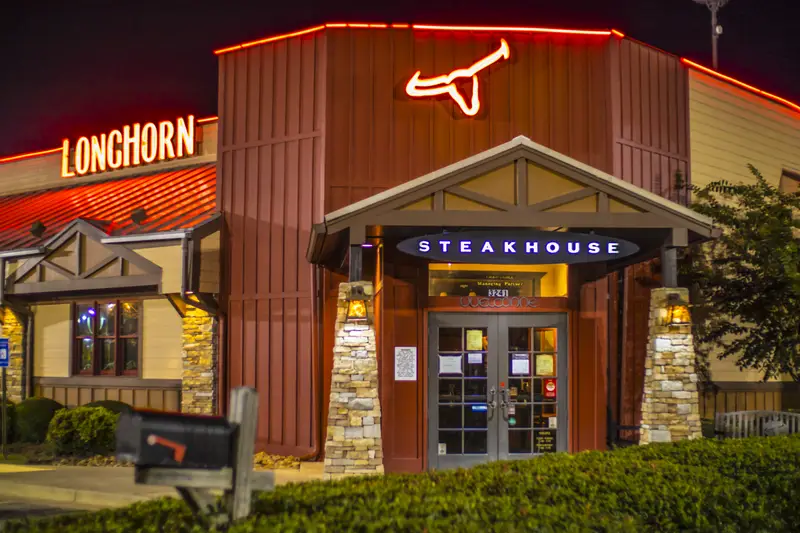
There’s something almost sacred about going out for a steak. You sit down, order something with a bone in it, and for forty-five minutes, you get to pretend you’re someone who deserves a nice meal. That’s the deal. That’s the social contract. But too many steakhouse chains in America have broken that contract — charging you real money for mediocre beef, soggy sides, and an experience that makes you wish you’d just fired up the grill at home.
I’m not talking about your corner mom-and-pop steakhouse that’s been around since 1974 and still dry-ages in-house. I’m talking about the big chains — the ones plastered across every highway exit and suburban strip mall. Some of them are fine. Some of them are actively bad. And based on thousands of reviews from real diners on Yelp, TripAdvisor, and Google, a handful of them have earned a reputation for being genuinely not worth your time or money.
Here are the steakhouse chains that keep disappointing people, ranked from bad to worst.
Texas Roadhouse
This one’s going to be controversial. Texas Roadhouse has legions of fans, and honestly, compared to the other names on this list, it’s the least offensive. The rolls with cinnamon butter are famous for a reason. The prices are reasonable. Some locations genuinely put out a decent steak.
But here’s the problem: consistency. Texas Roadhouse is a franchise, and the experience varies wildly depending on where you are. Some locations are clean, well-run, and cook a respectable ribeye. Others serve steaks that taste like they were cooked by someone who learned on YouTube an hour ago. The reviews reflect this — you’ll find glowing five-star posts sitting right next to one-star rants about steaks that came out grey and cold. When a chain has over 700 locations, quality control becomes a real issue. You might get a great meal. You might get a steak that belongs in a school cafeteria. That’s a gamble nobody should have to take when they’re paying $20 or more for a plate.
Saltgrass Steakhouse
Saltgrass is owned by Landry’s, Inc., the same company behind Bubba Gump Shrimp Co. and Rainforest Cafe. That should tell you something. It’s a Texas-based chain with locations mostly in the South and Southwest, and it markets itself as a premium steakhouse experience. The pricing reflects that — you’re looking at $30 to $50 for a steak entrée, which puts it in the same ballpark as places that actually age their beef properly.
The complaints from reviewers tend to center on one thing: the steak doesn’t match the price. For what Saltgrass charges, people expect something a step above what they can get at a cheaper chain. Instead, many report steaks that are tough and underseasoned, with sides that feel like afterthoughts. The bread is good. The atmosphere tries hard. But at those prices, “tries hard” isn’t good enough.
Claim Jumper
Claim Jumper is a chain that peaked somewhere in the early 2000s and has been in slow decline since. They started in California in 1977, and at their height, they had locations all over the West Coast. Now they’re down to a handful of restaurants, mostly in California, Nevada, and a few other states.
The concept was always “big portions in a lodge-style restaurant,” which sounds appealing until you realize that quantity was always doing the heavy lifting over quality. The steaks are large, sure. But reviewers consistently describe them as bland, overcooked, or just generally uninspired. The restaurants themselves often feel tired — worn carpeting, dim lighting that’s less “ambiance” and more “hiding something,” and menus that haven’t been meaningfully updated in years. When you’re competing against modern steakhouse options, resting on a 1990s playbook is a recipe for irrelevance.
Logan’s Roadhouse
Logan’s Roadhouse filed for bankruptcy not once, but twice — in 2016 and again in 2020. They’ve managed to claw back from the brink both times, but the scars show. The chain started in 1991 in Lexington, Kentucky, and was clearly trying to be the working man’s steakhouse: peanut shells on the floor, country music on the speakers, and steaks that wouldn’t break the bank.
The idea was solid. The execution, especially in recent years, has been rough. Online reviews paint a picture of a chain that’s cutting corners everywhere it can. Thinner cuts of meat, frozen sides, understaffed dining rooms, and a general sense that the whole operation is running on fumes. Some locations have been closing, and the ones that remain often get dinged for slow service and food that tastes like it came off a Sysco truck about fifteen minutes before it hit your plate. At $15 to $25 a steak, there are better options at that price point.
Outback Steakhouse
I know, I know. The Bloomin’ Onion. The Aussie Cheese Fries. Outback has built a brand on fun appetizers and an Australian theme that no actual Australian would recognize. And for a long time, it worked. Outback was the go-to date night chain for millions of Americans.
But the steaks? They’ve been sliding for years. Outback has nearly 700 U.S. locations, and the quality control problems are well-documented across review sites. The most common complaints are steaks cooked to the wrong temperature, rubbery textures, and portions that seem to be shrinking while prices keep going up. A mid-range steak at Outback now runs $25 to $35, and for that money, people expect more than a steak that tastes like it was pre-seasoned and cooked on a flattop. The chain is owned by Bloomin’ Brands, which also runs Carrabba’s and Bonefish Grill, and the corporate assembly-line feel has bled into the steak quality. You go to Outback for the appetizers now. The steak is almost an afterthought.
Hoss’s Family Steak and Sea
Unless you live in Pennsylvania or a small part of West Virginia, you’ve probably never heard of Hoss’s. That’s fine. You’re not missing anything. Hoss’s is a regional chain with about 14 locations, and it operates in that weird middle ground between a buffet and a sit-down steakhouse — which means it does neither particularly well.
The restaurant has a salad bar and a hot buffet that comes included with some entrées, and the steaks themselves are priced low — we’re talking $12 to $20 range. At those prices, you get what you pay for. Reviewers describe the steaks as thin, chewy, and often overcooked. The buffet sides tend to sit under heat lamps long enough to develop a personality of their own. The whole experience feels like it hasn’t been updated since the Reagan administration. If you’re in rural Pennsylvania and want a cheap meal, Hoss’s will keep you fed. But if you’re looking for an actual steakhouse experience, keep driving.
Sirloin Stockade
Sirloin Stockade started in Oklahoma in 1966 and built its entire brand around the buffet-and-steak combo. At its peak in the ’80s and ’90s, there were Sirloin Stockades all over the Midwest and South. Now there are barely any left, and the ones that survive feel like time capsules — and not in a charming way.
The concept is simple: you order a steak, and you also get access to a buffet with things like mashed potatoes, macaroni and cheese, and soft-serve ice cream. The problem is that the steaks are some of the lowest-quality cuts you’ll find at any chain restaurant. We’re talking pre-portioned, sometimes frozen, cooked to whatever temperature the kitchen feels like that day. The buffet does the heavy lifting, and even that’s hit or miss. Stale rolls, lukewarm soup, and a dessert bar that looks like it gave up. At around $12 to $18 a person, the prices are low, but reviewers on multiple review sites say it’s still not worth it.
Sizzler
Sizzler is the chain that time forgot. Founded in 1958 in Culver City, California, Sizzler was once a powerhouse — at its peak, there were over 600 locations worldwide. Now there are fewer than 100, mostly in California, with a scattering in other states. The chain filed for bankruptcy in 1996 and again in 2020, and it shows.
Sizzler tries to be a steakhouse, a seafood restaurant, and a salad bar all at once, and it fails at all three. The steaks are the main event on paper, but reviewers describe them as some of the worst chain-restaurant steaks in America — tough, flavorless, and often served on a sizzling plate that does more for presentation than it does for taste. The salad bar, which was once the chain’s claim to fame, now feels like a sad obligation. Wilted lettuce, canned fruit cocktail, and that mysterious soup that’s always been there.
Prices hover around $15 to $25 for a steak combo, which isn’t outrageous, but that money goes a lot further at almost any other restaurant. Sizzler is surviving on nostalgia and brand recognition at this point, and neither of those things makes a steak taste better. Of all the chains on this list, Sizzler is the one that most consistently disappoints people who walk through its doors expecting something edible.
The Takeaway
If you want a good steak in America, you have options — but most of these chains aren’t it. The worst offenders on this list, particularly Sizzler, Sirloin Stockade, and Hoss’s, are serving steaks that wouldn’t pass muster at a backyard cookout, let alone a restaurant. Even the bigger names like Outback and Logan’s Roadhouse have slipped far enough that the reviews speak for themselves.
The best advice? If you want a chain steakhouse experience, read recent reviews for the specific location you’re planning to visit. Quality varies hugely from one restaurant to another, even within the same brand. Or — and I know this sounds radical — spend $30 on a good cut from a butcher, watch a five-minute video on how to reverse-sear, and eat the best steak you’ve had in months. Your wallet and your stomach will both thank you.
