

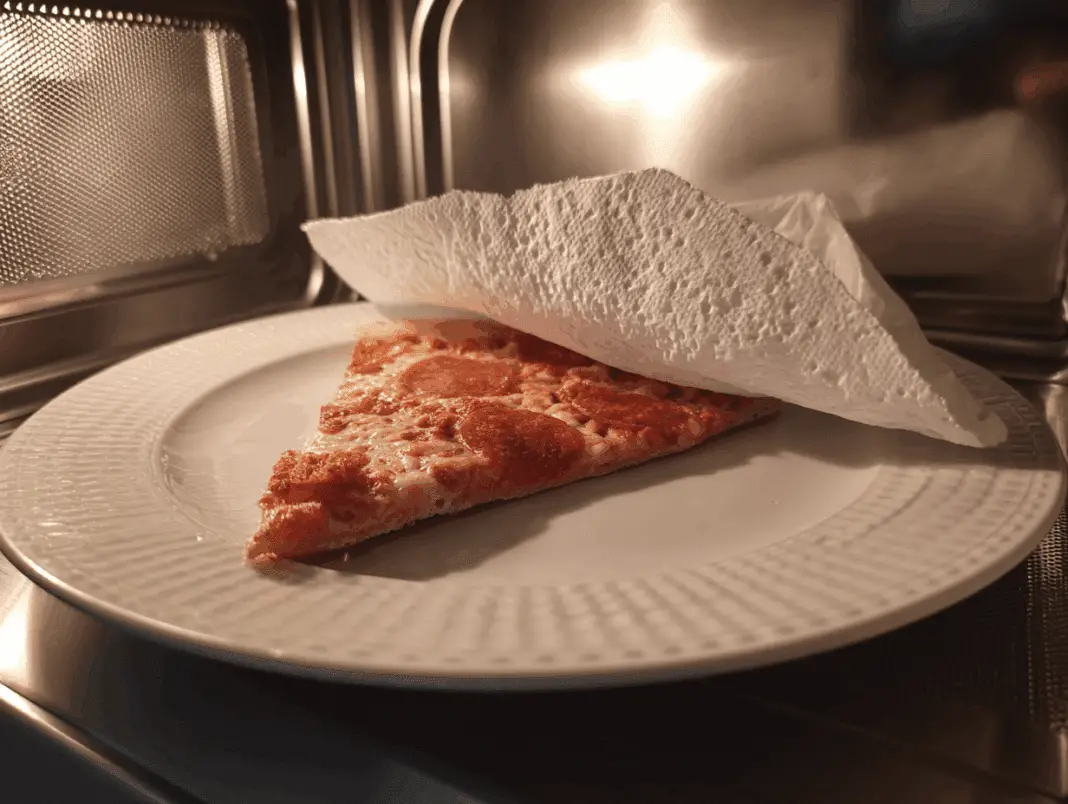
You’ve done it a hundred times. Maybe a thousand. You heat up leftover spaghetti, cover it with a paper towel to keep the sauce from splattering everywhere, and hit start. Thirty seconds later, dinner’s ready and nothing bad happened. So what’s the big deal?
Here’s the thing — most of the time, nothing goes wrong. And that’s exactly why people never question it. But “most of the time” isn’t “always,” and the gap between those two phrases is where things get interesting. There are real scenarios where tossing a paper towel into the microwave can lead to fire, chemical exposure, or a mess you didn’t sign up for. The question isn’t whether paper towels are always dangerous in a microwave. It’s whether you’re using them in a way that’s actually safe — and a lot of people aren’t.
The Dry Paper Towel Problem Nobody Talks About
This is the one that catches people off guard. When you drape a paper towel over a plate of food, the food underneath is wet — it has moisture, oils, sauces, something. The microwave’s energy gets absorbed by that moisture, and the paper towel kind of just goes along for the ride. But if you microwave a dry paper towel by itself — or one that’s sitting far enough from the food that it doesn’t pick up any steam — that’s a completely different situation.
A dry paper towel has no moisture to absorb the microwave radiation. Instead, the energy has to go somewhere, and it starts heating the paper towel directly. Paper towels aren’t designed for that. They’re thin, lightweight, and absolutely flammable at the right temperature. Under normal conditions, it takes sustained heat to ignite paper — around 451°F, which is where Ray Bradbury got his book title. A microwave can absolutely generate that kind of heat in a small area if there’s nothing else absorbing the energy.
Most people never run a microwave with just a paper towel inside and nothing else. But it happens more than you’d think — someone wipes down the inside with a paper towel, forgets it’s in there, then hits reheat. Or they ball up a paper towel and stick it in to “dry out” a damp microwave interior. Both are bad ideas.
Recycled Paper Towels Come With a Hidden Risk
This one is genuinely alarming, and most people have zero idea about it. Paper towels made from recycled materials can contain trace amounts of metal. Not like chunks of aluminum — we’re talking microscopic metal particles that ended up in the recycled paper pulp from staples, paper clips, foil labels, and other bits that went through the recycling process.
You know what happens when metal goes in a microwave. Even tiny fragments can cause sparking. And sparking plus dry paper equals a potential fire. It doesn’t happen every time, and the metal content varies from brand to brand and even batch to batch. But it’s a real, documented issue. If you’re using store-brand recycled paper towels and microwaving them regularly, you’re rolling dice with odds you can’t see.
This doesn’t mean all recycled paper products are dangerous. It means that the combination of recycled fibers, trace metals, and microwave radiation creates a risk that doesn’t exist with virgin-fiber paper towels. If you want to be safe, look for paper towels that specifically say they’re microwave-safe, or stick with plain white, non-recycled options when you’re using them in the microwave.
Printed Paper Towels Are Not the Same as Plain White Ones
Walk down the paper towel aisle at Target or Walmart and you’ll see all kinds of designs — flowers, geometric patterns, seasonal prints. They look nice on the counter. They do not look nice melting chemicals into your food.
The dyes and inks used on printed paper towels weren’t formulated with microwave safety in mind. When exposed to heat, some of those inks can transfer onto food or release compounds into the steam that rises off your plate. The general recommendation from multiple sources is to stick with all-white paper towels when you’re using them in the microwave. No prints, no patterns, no colored borders.
Is one exposure going to make you sick? Probably not. But think about how often you use paper towels in the microwave. If it’s daily — covering your morning oatmeal, your lunch leftovers, your evening reheats — those small exposures add up over months and years. It’s such an easy fix (just buy a roll of plain white ones for microwave use) that there’s no good reason to ignore it.
Some Paper Towels Contain Chemicals You Don’t Want Near Hot Food
Beyond the printed designs, the paper towel itself might be carrying chemical baggage. Some brands use chlorine bleach in their manufacturing process. Others add wet-strength agents — chemicals that keep the paper towel from falling apart when it gets wet. These are great for cleaning up spills. They’re less great for being pressed against hot food inside a sealed microwave.
When you heat a paper towel in the microwave, especially one that’s in direct contact with steaming food, there’s a chance those chemical compounds can migrate. The FDA has standards for food-contact materials, and most major paper towel brands meet them. But “most” and “all” aren’t the same word, and bargain-bin paper towels from unknown manufacturers might not have the same level of testing.
If you’re going to use paper towels in the microwave — and again, it’s generally fine if you do it right — opt for brands that specifically label themselves as food-safe or microwave-safe. Bounty, Viva, and other big names generally pass safety standards. But that random 12-pack from the dollar store? Maybe keep those for cleaning the counters.
How Long Is Too Long?
Time matters more than most people realize. Reheating something for 30 to 60 seconds with a paper towel on top? That’s within the range that pretty much everyone agrees is safe. Running the microwave for five minutes with a paper towel draped over a big casserole dish? Now you’re in a gray area.
The longer a paper towel sits in a running microwave, the more heat it absorbs, and the drier it gets as any moisture in the food evaporates. At some point, you’ve got a dry, hot paper towel sitting in an active microwave with no moisture left to absorb the energy. That’s the danger zone. Even microwave-safe paper towels have their limits. Keep it short, keep it supervised, and don’t walk away.
A good rule: if you’re microwaving something for more than two minutes, ditch the paper towel and use a microwave-safe lid or plate instead. They do the same job — preventing splatter — without any fire risk.
The Folded-Up Paper Towel Trap
Some people fold paper towels into thick pads before microwaving them — maybe to absorb extra grease from bacon or to create a sturdier cover. The problem is that layered paper towels trap heat between the folds. The inner layers can get significantly hotter than the outer ones, creating hot spots that can scorch or ignite.
If you’re using paper towels to absorb grease (like wrapping bacon before microwaving it), use a single layer. Lay the strips flat between individual sheets rather than stacking towels three or four deep. And check on it. Bacon fat renders at high temperatures, and combined with dry paper in a confined space, you’re creating conditions that could go sideways if you set the timer too long and walk away.
Better Alternatives That Cost Almost Nothing
If all of this is making you rethink your paper towel microwave habit, good. There are simple swaps that eliminate the risk entirely.
A microwave-safe plate flipped upside down over a bowl works perfectly as a splatter guard. You probably already own one. Microwave-safe glass lids, silicone covers, and even damp (not wet) cloth napkins all work. You can buy a dedicated microwave splatter cover on Amazon for about three bucks — they last for years and go in the dishwasher.
Wax paper is another option that people forget about. It’s microwave-safe, doesn’t carry the same chemical concerns as printed paper towels, and works just as well for covering dishes. Cut a sheet, lay it on top, and you’re done.
The Real Takeaway
Paper towels in the microwave aren’t an automatic disaster. Millions of people use them every day without incident. But there’s a difference between “usually safe” and “always safe,” and the situations where things go wrong are surprisingly common — dry towels, long cook times, recycled materials with trace metals, printed designs leaching ink onto food.
The fix is simple. Use plain white paper towels if you’re going to use them at all. Keep cook times short. Never microwave a dry paper towel by itself. And if you’re reheating something that takes more than a couple of minutes, grab a proper microwave cover instead. These are small adjustments, but they’re the difference between a boring, uneventful dinner and a kitchen that smells like smoke.
