

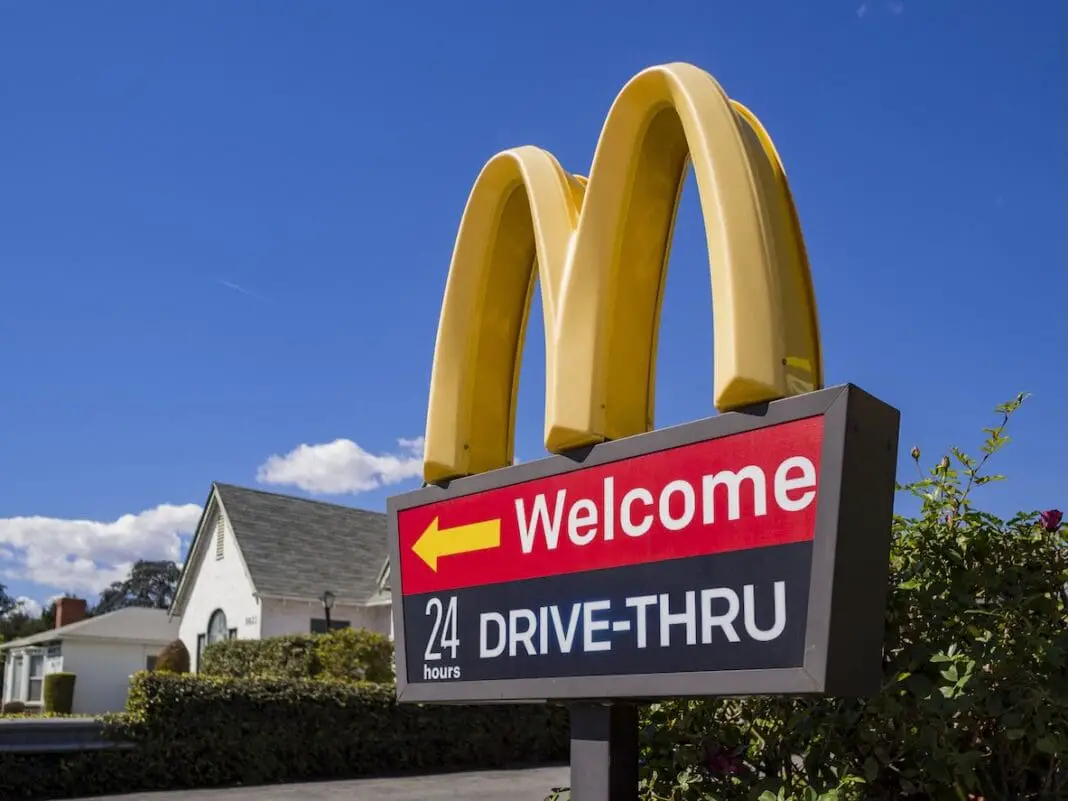
If you’ve ever pulled up to a McDonald’s drive-thru, shouted your order three times into a crackling speaker, and still ended up with somebody else’s food — well, McDonald’s knows. They know it’s a problem. They’ve known for a while. And now they’re throwing a staggering amount of money and technology at fixing it.
The company is rolling out a suite of changes across roughly 27,000 drive-thru locations worldwide, with the heaviest action happening in 2026 and a target to wrap things up by 2027. We’re talking AI-powered ordering, scales that weigh your bag before you get it, extra lanes, and an app that starts cooking your food before you even pull into the parking lot. Some of these ideas sound legitimately great. Others? We’ll see.
Here’s what’s actually changing and why it matters to anyone who eats fast food in America — which, statistically, is most of us.
AI Chatbots Are Taking Your Order (Again)
McDonald’s tried this before. Back in 2021, the company partnered with IBM to test AI voice ordering at about 100 U.S. locations. It did not go well. Customers posted TikTok videos of the system adding nine sweet teas to a single order. One woman tried to order water and vanilla ice cream and got completely wrong items. The whole thing became a viral mess, and McDonald’s pulled the plug in 2024.
But they haven’t given up on the idea. Not even close. In December 2023, McDonald’s announced a massive partnership with Google Cloud to develop new AI tools across its restaurants. The new voice chatbots are supposed to be dramatically better than the IBM version — better at understanding speech in noisy environments, better at processing natural language, and connected to real-time cloud updates so they actually improve over time.
McDonald’s Chief Information Officer Brian Rice has been blunt about why this matters. He told the Wall Street Journal that crew members are getting crushed by the sheer volume of demands — counter orders, drive-thru orders, delivery couriers, curbside pickups, all happening at once. “That’s a lot to deal with for our crew,” Rice said. “Technology solutions will alleviate the stress.”
There’s just one awkward detail: a YouGov poll found that 55% of people would still rather talk to a human when placing an order. McDonald’s is betting that if the AI actually works this time, people will come around. That’s a big if.
Scales That Weigh Your Bag Before You Drive Off
This one is genuinely clever. McDonald’s has started deploying what it calls AI-powered Accuracy Scales across thousands of locations. The concept is simple: before your bag gets handed through the window, it goes on a scale. The system knows what you ordered. It knows what that order should weigh. If the numbers don’t match, a crew member gets flagged to open the bag and check before you drive away with a missing Quarter Pounder.
The weight targets are based on the number and type of items in each order. It’s not going to catch everything — if they put pickles on your burger when you said no pickles, the scale won’t know. But missing items? An entire sandwich that didn’t make it into the bag? That should get caught.
McDonald’s has already deployed these scales across drive-thrus, self-ordering kiosks, and delivery channels in a dozen markets. Given that the company serves an estimated 63 million people every day, even a small improvement in accuracy adds up fast. For customers, it means fewer of those moments where you’re already on the highway before you realize your fries are gone.
Multi-Lane Drive-Thrus Are Spreading Fast
About 70% of all McDonald’s orders come through the drive-thru. That’s not a typo. Seven out of ten customers never walk inside. So when McDonald’s talks about adding lanes, they’re talking about the core of the business.
Many locations already have double-lane setups, but the next wave will push some high-traffic stores to three lanes. One of those lanes will be a dedicated “fast lane” for mobile-order pickups — basically, if you ordered on the app before you arrived, you skip the line entirely.
McDonald’s announced these physical upgrades back in late 2023 as part of broader development targets, and they expect major progress in 2026. The idea is straightforward: more lanes means more cars served per hour, which means shorter waits and more revenue.
But not everyone’s thrilled. Some customers have raised concerns that multiple lanes could create confusion — people not knowing which lane to get in, cars trying to merge, the kind of low-grade parking lot chaos that makes you wish you’d just gone inside. Whether the design actually reduces wait times or just moves the bottleneck to a different spot will depend on how well each location handles the layout.
Your Food Starts Cooking Before You Arrive
McDonald’s is expanding something called the Ready on Arrival program, and it’s one of the more interesting pieces of this whole overhaul. The system uses geofencing — a virtual boundary around each restaurant — linked to the McDonald’s mobile app. When your phone crosses that boundary, the restaurant gets an alert. Kitchen staff start preparing your order immediately.
The goal is simple: by the time you pull up to the window, your food is already done or close to it. No sitting in the parking spot waiting. No idling in the lane while they scramble to make your Big Mac.
The program is being scaled to six additional markets, with the U.S., Japan, and the U.K. leading the way. Given how many people already order through the app — McDonald’s reported hundreds of millions of mobile orders in a single quarter of 2023 — this could make a real dent in wait times for a huge chunk of customers.
Smart Kitchen Equipment That Fixes Itself
This might be the change that gets the most applause from the internet. McDonald’s is putting AI sensors on kitchen equipment — including fryers and, yes, ice cream machines. These sensors will monitor equipment in real time and proactively notify workers when something needs maintenance or is about to break down.
The broken McFlurry machine has been a running joke for years. There are entire websites dedicated to tracking which McDonald’s locations have working ice cream machines. If these AI sensors actually work, it could mean fewer breakdowns and faster repairs when problems do happen. McDonald’s CEO Chris Kempczinski has talked about the Google partnership in terms of finding the best ways to use AI across every part of the restaurant, and kitchen equipment is clearly a priority.
The tech runs on what McDonald’s and Google are calling the Edge platform — basically, computing hardware installed directly in each restaurant that can process data locally while still connecting to Google’s cloud. This means things like inventory tracking, equipment diagnostics, and menu recommendations can all happen in real time without depending entirely on an internet connection.
Digital Menu Boards That Change Based on the Weather
This one’s already been rolling out for a while, but it’s getting smarter. McDonald’s spent $300 million acquiring a company called Dynamic Yield back in 2019, and they’ve been using that technology to power AI-driven menu boards at drive-thrus across the country. These boards don’t just show you the menu — they change based on time of day, weather, how busy the restaurant is, and what’s trending at that location.
Rainy afternoon? You might see a $1.49 apple pie offer pop up. Lunch rush hitting hard? The board pushes combo deals to move traffic faster. If the restaurant is running low on beef patties, the system can quietly push chicken sandwiches and salads instead. And with 150 million MyMcDonald’s Rewards users feeding data into the system, repeat customers might see offers based on their own past orders.
It’s the kind of thing that an online retailer would do on a website, except it’s happening on a glowing screen while you’re sitting in your car trying to decide between a McChicken and a 10-piece.
Cash Is Getting Harder to Use
In May 2025, the U.S. Treasury halted penny production, leading to a coin shortage. McDonald’s responded in November 2025 with a rounding system for cash payments. If you don’t have exact change, your total gets rounded to the nearest five cents — sometimes up, sometimes down. Menu prices haven’t changed, but your actual total might shift by a few pennies depending on which direction the rounding goes.
McDonald’s still accepts cash, and they still take card and tap-to-pay. But the rounding policy is a nudge — a not-so-subtle push toward digital payments. Between this and the mobile-order fast lanes, the message is clear: McDonald’s wants you on the app. They want your loyalty data. They want to know what you order, when you order, and where you are when you’re heading their way.
Will Any of This Actually Work?
McDonald’s isn’t the only chain trying to figure this out. Wendy’s has been testing its own AI ordering system called FreshAI. Chick-fil-A is investing in drive-thru technology. Chipotle has opened over 500 digital-only Chipotlane locations. Taco Bell and Pizza Hut are testing kitchen robots and AI tools. The entire fast-food industry is racing toward automation, and McDonald’s — with its 43,000 restaurants and Google’s backing — has more resources than almost anyone else in the game.
But resources don’t guarantee success. The IBM partnership proved that. Customers have long memories for bad experiences, and the viral TikTok videos of botched AI orders are still floating around. The global AI market is projected to grow from $235 billion in 2024 to $631 billion by 2028, and about 62% of restaurant executives say AI gives them a competitive edge. The money is flowing in one direction.
Whether that translates into you actually getting the right order at the drive-thru is a completely different question. McDonald’s is confident. Customers are skeptical. And somewhere, right now, an ice cream machine is broken.
