

I ruined eggs for years. Truly awful eggs — chalky, gray-green yolks that smelled vaguely like a middle school science lab. I thought that’s just what hard-boiled eggs were. Turns out I was doing almost everything wrong, and there’s a decent chance you are too.
The hard-boiled egg should be the simplest thing anyone can cook. Egg. Water. Heat. Done. But there’s a reason so many of us end up with rubber-textured whites, crumbly yolks, and shells that take off half the egg white when we peel them. The mistakes are small and sneaky, and most people have been repeating them since they first boiled water.
Let’s fix that.
The Overcooking Problem Is Way More Common Than You Think
If your hard-boiled eggs have ever come out with a gray-green ring around the yolk, congratulations — you overcooked them. Nick Korbee, the chef behind Egg Shop in New York, calls this the “Death Star Effect.” The egg gets so beaten up by boiling water that the yolk turns into something that looks like a depressing planet and tastes like sulfur. His words were more colorful than mine — he compared the smell to chronic flatulence. Which, honestly, tracks.
Here’s what’s actually happening in there. According to Dawn M. Bohn, PhD, a teaching associate professor in the Department of Food Science and Human Nutrition at the University of Illinois at Urbana-Champaign, it’s a chemical reaction between hydrogen sulfide in the egg white and iron in the yolk. When you apply too much heat for too long, those compounds react and form ferrous sulfide right on the surface of the yolk. That’s the green-gray ring. That’s the smell. That’s why your egg salad tastes sad.
The ring is safe to eat. Nobody’s going to the hospital over it. But it’s a sign you pushed the egg too far, and it’s dragging down the flavor and texture of everything you make with it.
Stop Actually Boiling Your Eggs
This is the big one. The thing that changed everything for me. The best way to make “hard-boiled” eggs is to barely boil them at all.
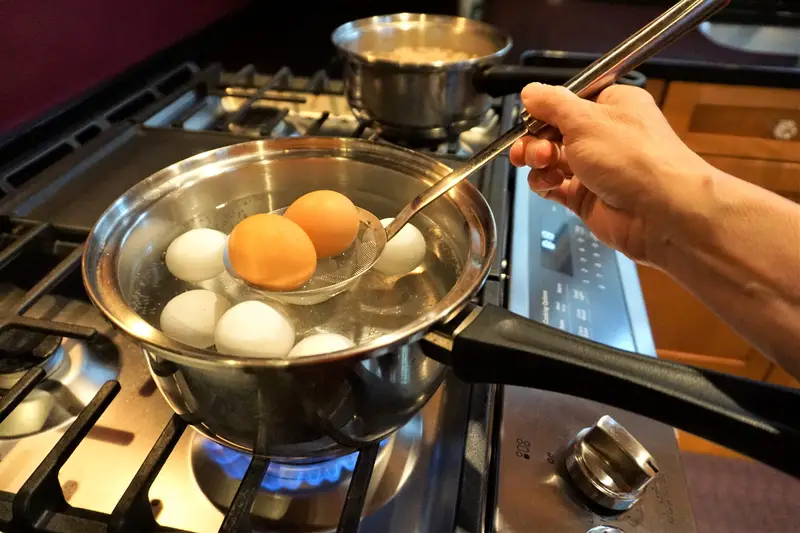
The method that most experts agree on goes like this: put your eggs in a saucepan in a single layer, cover them with cold water, and bring it to a boil over medium-high heat. The second it hits a rolling boil, kill the heat. Put the lid on. Walk away for 10 to 12 minutes. That’s it. The residual heat in the water does the actual cooking without brutalizing the egg.
For medium eggs, 12 minutes is the sweet spot. Extra-large eggs need closer to 18 minutes. Korbee prefers a different approach — dropping eggs into already-boiling water and timing nine minutes for a creamy yolk, 11 minutes for a firmer one that works better for deviled eggs. Either way, the principle is the same: controlled heat, precise time, and not a minute more.
If you’ve been leaving your eggs at a full rolling boil for 15 or 20 minutes, you’ve been cooking them at roughly double the intensity they need. No wonder they come out looking like the moon.
You’re Using the Wrong Eggs
This one is counterintuitive. You’d think the freshest eggs would make the best hard-boiled eggs. Nope. Fresh eggs are actually terrible for boiling because they’re almost impossible to peel cleanly.
Here’s why. As eggs age, two things happen. First, they lose moisture through tiny pores in the shell, which makes the air pocket at the fat end of the egg grow larger. Second, the pH level of the whites rises over time, which causes them to stick less to the inner shell membrane. Fresh eggs have a lower pH, so the whites bond tightly to the membrane. That’s why you end up picking at tiny shell fragments for ten minutes and destroying half the egg in the process.
The fix is easy: buy your eggs a week or two before you plan to boil them. Let them hang out in the fridge. And here’s the thing — eggs you buy at the grocery store are probably already older than you think. Between packaging and shelf time, supermarket eggs in the U.S. can be up to two months old before you bring them home. So those store-bought eggs sitting in your fridge for a week? Perfect candidates.
Just don’t use expired eggs. If you’re ever unsure, do the float test. Fill a bowl with water and drop the egg in. If it sinks and lies flat, it’s fresh. If it stands upright on the bottom, it’s older but still good — actually ideal for boiling. If it floats to the surface, throw it out.
The Ice Bath Isn’t Optional
Skipping the ice bath is like running a marathon and stopping 50 feet before the finish line. You did all that work and then let the egg keep cooking in its own residual heat while it sits on the counter.
Lisa Steele, a fifth-generation chicken keeper and author of The Fresh Eggs Daily Cookbook, explains exactly what happens. When you plunge a cooked egg into ice water, it forces the hydrogen sulfide away from the yolk and toward the shell. That’s what prevents the green ring from forming around the yolk. It also creates a kind of separation between the egg white and the shell membrane, which is what makes peeling possible without mangling everything.
The ice bath needs to be actual ice water, not just cold tap water. And the eggs need to stay in there until they’re fully cooled — at least 15 minutes. Even an egg that feels cool when you hold it might still have residual heat trapped inside. Don’t rush it. You spent all this time cooking them right. Give them 15 minutes in the ice bath.
Your Pot Is Too Small
I used to cram a dozen eggs into whatever saucepan was already clean. Bad idea. When eggs are stacked on top of each other or jammed together, they cook unevenly. The ones on the bottom get more direct heat. The ones on top are basically steaming in a different environment. You end up with some eggs that are perfect, some that are underdone, and a couple that are overcooked and cracked.
Eggs need to sit in a single layer with a little room to move around. If you’re cooking a dozen eggs and they don’t all fit in one layer in your pot, use a bigger pot or do two batches. It takes an extra ten minutes and saves you from the frustration of biting into a yolk that’s still runny on one side and chalky on the other.
Cold Water Start vs. Boiling Water Start — The Great Debate
There’s genuine disagreement among experts about whether you should start eggs in cold water and bring everything up together, or drop eggs into water that’s already boiling. Both camps have their reasons.
The cold-water method is more forgiving. Bringing the water and eggs up in temperature together reduces the chance of cracking and promotes more even cooking. It’s harder to mess up. The boiling-water method gives you more control over timing since you know exactly when the cooking starts. Korbee swears by it. Steele uses it too.
Honestly? Both work. The cold-water method is better if you’re not standing over the stove with a timer. The boiling-water method is better if you want precision. The one thing everyone agrees on is what happens after — the ice bath, the cooling, the patience. That part isn’t up for debate.
Don’t Peel Them Warm
I know. You’re hungry. The eggs are done. You want to eat one right now. But peeling a warm egg is asking for trouble. When the egg is still warm, the whites and the shell are bonded more tightly together. You’ll tear chunks of white off with the shell and end up with something that looks like it survived a hailstorm.
Cool them completely first. After their ice bath, you can peel them or store them in the fridge with the shells still on for up to a week. When you’re ready to peel, gently tap the egg on a hard surface to crack the shell all over, then roll it between your palms. The shell should come off in large satisfying pieces instead of tiny maddening shards.
A Few Extra Tricks That Actually Work
Adding a splash of vinegar and a pinch of salt to your cooking water can help with peeling. The vinegar slightly dissolves the shell, and if an egg does crack during cooking, the vinegar helps the white coagulate faster so it doesn’t leak out everywhere.
Use a timer. Seriously. This might be the single most important piece of advice. Korbee recommends it, and he runs a restaurant literally named after eggs. Nine minutes for a creamy center. Eleven for firm. Whatever method you use, set the timer and respect it. Winging it is how you end up with the Death Star.
And if you already made a batch of green-ringed eggs and don’t want to waste them? Mash the yolks into avocado toast where the green blends right in, or stir some fresh herbs and chopped olives into your egg salad to mask the color and any off flavors.
Hard-boiled eggs aren’t hard. They’re just less forgiving than people assume. A couple minutes too long, a skipped ice bath, eggs that are too fresh — any one of these will give you a mediocre result. But once you fix these small things, you’ll wonder how you ever ate those gray, rubbery eggs and thought they were normal. They weren’t. You just didn’t know any better. Now you do.
