

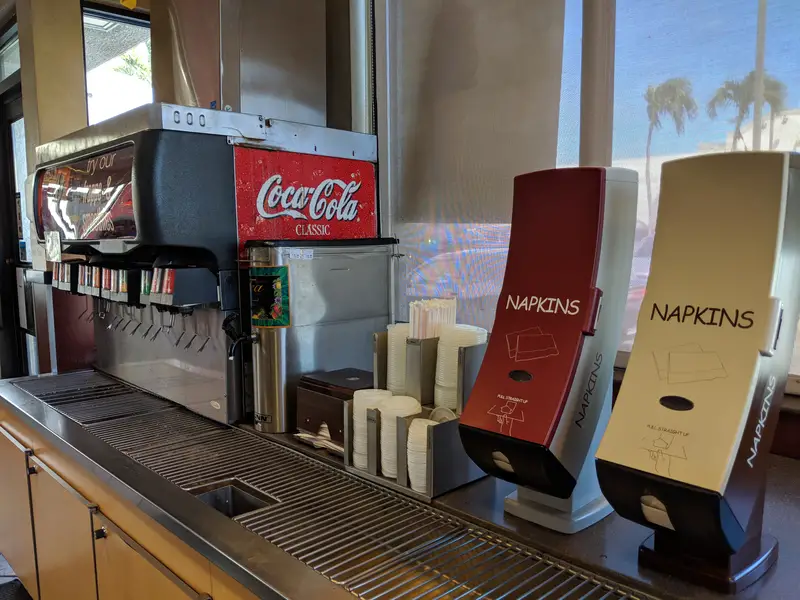
If you’ve walked into a McDonald’s lately and noticed something missing, you’re not imagining things. That soda fountain you’ve been filling your own cup at since 2004? It’s disappearing. McDonald’s confirmed it’s pulling every single self-serve beverage station from its U.S. dining rooms by 2032. Some locations have already ripped theirs out. And the corporate explanation — “creating a consistent experience” — barely scratches the surface of what’s actually going on.
This is about money, changing habits, shrinking restaurants, and a fast-food industry that’s quietly reinventing itself while most of us are just trying to get a Big Mac and a Coke. Here’s everything behind this move and what it actually means for you the next time you eat inside a McDonald’s.
The “Consistent Experience” Line Is Corporate Speak
McDonald’s official statement says the switch is about making the experience the same whether you order through the app, kiosk, drive-thru, delivery, or in-person at the counter. The logic: if drive-thru customers already get their drinks poured by crew members, why should dine-in customers operate differently?
That sounds reasonable until you think about it for five seconds. Nobody walks into a McDonald’s dining room and thinks, “Gee, I wish this felt more like the drive-thru.” The real reasons are stacked behind that PR-friendly language, and they’re a lot more interesting than “consistency.”
Almost Nobody Eats Inside Anymore
Here’s the big one. Even before COVID-19 hit, more than two-thirds of McDonald’s business came through the drive-thru. After the pandemic, that number climbed even higher. Between February 2020 and 2022, delivery orders across the fast-food industry jumped 116%, online ordering increased 117%, and drive-thru grew by 20%. The dining room became the least popular way to get your food.
So think about this from a franchise owner’s perspective. You’ve got a soda machine sitting in the dining room that requires plumbing, maintenance, cleaning, syrup bags, and floor space — all for a shrinking group of customers who actually sit down and eat. Meanwhile, the crew is already pouring drinks for the majority of customers who never touch that machine. At a certain point, the self-serve station is furniture that costs money.
Digital Sales Are Running the Show Now
McDonald’s digital sales — that’s app orders, delivery, and kiosk purchases — made up about 40% of all sales across the company’s top six markets during the second quarter. That figure surpassed $8 billion in just one quarter. Staff have already been pre-filling drinks for mobile orders for years now.
Franchisee Mikel Petro, who operates 15 McDonald’s locations in Illinois, put it plainly: it’s an evolution toward convenience and the result of digital service growth. When 40% of your business comes through a screen and those customers never walk near a soda fountain, the machine starts looking like a relic from a different era of fast food.
The Free Refill Math Is Brutal
Alex Susskind, a professor of food and beverage management at Cornell University, did some rough math that puts the refill situation in perspective. McDonald’s serves about 25 million customers per day in the United States. If 20% of those customers dine in and half of them grab a free refill, and McDonald’s pays roughly 10 cents per drink, that works out to about $250,000 a day in free soda. That’s more than $90 million a year.
“That is real money,” Susskind said. And those are conservative estimates. Now, McDonald’s hasn’t said it’s eliminating free refills. Franchise owner Kim Derringer stressed that free refills are a huge draw and she doesn’t see them going away. But here’s the catch: individual franchise owners get to decide their own refill policies. And without a self-serve machine sitting right there, asking you to help yourself, the friction of walking back to the counter and requesting another drink could reduce refill rates dramatically — even if they’re technically still free.
The Water Cup Scam Finally Dies
Every McDonald’s employee knows this one. A customer asks for a free water cup, walks over to the self-serve machine, and fills it with Sprite instead. It’s been happening for decades and franchise owners have listed theft prevention as one of the reasons behind the change.
Is it a huge financial hit per cup? No. But multiply it across 14,300 U.S. locations and it adds up. More importantly, it’s the kind of low-level problem that disappears entirely once you move the machine behind the counter. No confrontation with customers, no awkward signage about water cups — just a problem that ceases to exist.
Food Safety and Hygiene Concerns
Self-serve soda machines in fast-food restaurants are touched by hundreds of people a day. The nozzles, the ice lever, the drip tray — none of it gets cleaned between customers. During the pandemic, most of these stations were shut down entirely because of contamination risks. Many crew members got used to pouring drinks from a back-of-house system during that time.
The new crew-pour system uses automated beverage machines that minimize human contact. It’s not just about the customer touching the machine — it’s about reducing the variables entirely. Some customers who’ve spoken up in favor of the change specifically mentioned how dirty and poorly maintained many self-serve stations were. If you’ve ever looked closely at the nozzle on one of those machines, you know exactly what they’re talking about.
McDonald’s Restaurants Are Getting Smaller
This is a detail most people miss. McDonald’s has been quietly experimenting with smaller restaurant formats. At the end of 2022, the company opened a test location near Fort Worth, Texas that was 26% smaller than the average McDonald’s. They’ve also been testing a small-format concept called CosMc. As dining rooms shrink, operators need that floor space for other things — more efficient kitchen layouts, additional ordering kiosks, or just a better-looking dining area.
A self-serve beverage station takes up real estate. It needs plumbing. It needs to be near an outlet. It needs a trash can next to it and enough room for a few people to stand around. When you’re trying to build a smaller, leaner restaurant optimized for speed and takeout, that’s space you can’t afford to waste.
What Customers Are Actually Losing
Let’s be honest about what this takes away. The ability to control your own ice-to-drink ratio? Gone. Mixing half Dr Pepper and half Hi-C like you’re a soda scientist? Gone. Walking over and topping off your drink whenever you want without talking to anyone? Also gone.
Reactions online have been split. A Reddit thread about the change racked up nearly 350 comments, with people from Europe pointing out they never had free refills at McDonald’s in the first place. American customers, though, see it differently. The self-serve fountain was part of the deal. You paid for a meal and the soda was practically bottomless. Now you’ll have to walk to the counter, wait in line, and ask a crew member to refill your cup. For a lot of people, that’s enough friction to make them just not bother — which, of course, is probably part of the point.
Other Chains Are Watching Closely
Darren Tristano, CEO of FoodserviceResults, a research and consulting firm, said McDonald’s is a leader in the industry and when they make big moves, other fast-food chains tend to follow. If this works — if McDonald’s saves money, reduces waste, and customers don’t revolt — expect Burger King, Wendy’s, and others to start doing the same thing.
The entire fast-food industry is shifting its business model right now. Companies are testing digital-only restaurants, seatless restaurants, mobile-order pickup windows, and AI-powered drive-thru ordering. Wendy’s, Panera Bread, Carl’s Jr., Hardee’s, and Popeyes are all experimenting with artificial intelligence at the drive-thru. The self-serve soda machine might feel like a small thing, but it’s connected to a much bigger transformation in how these companies operate.
The Timeline and What to Expect
McDonald’s has given itself until 2032 to complete the full transition across all U.S. locations. Some franchise locations in Illinois were among the first to remove their machines. Locations in California, Florida, and Pennsylvania have also started making the switch. Franchise owner Kim Derringer said late 2024 would be the earliest any of her restaurants would go fully crew-poured.
At one of Mikel Petro’s Illinois locations, the transition is already halfway done. Staff fill initial drink orders for dine-in customers and deliver them to the table with the meal. Takeout customers at the counter still get an empty cup for now, but once a planned remodel moves the plumbing behind the counter, the self-serve station comes out for good.
If you mostly hit the drive-thru or order through the app, this changes absolutely nothing for you. Your drinks have always been poured by someone else. But if you’re one of those people who likes to sit down, eat slowly, and refill your Dr Pepper twice — enjoy it while you still can. That era has an expiration date, and it’s coming faster than 2032 suggests.
