

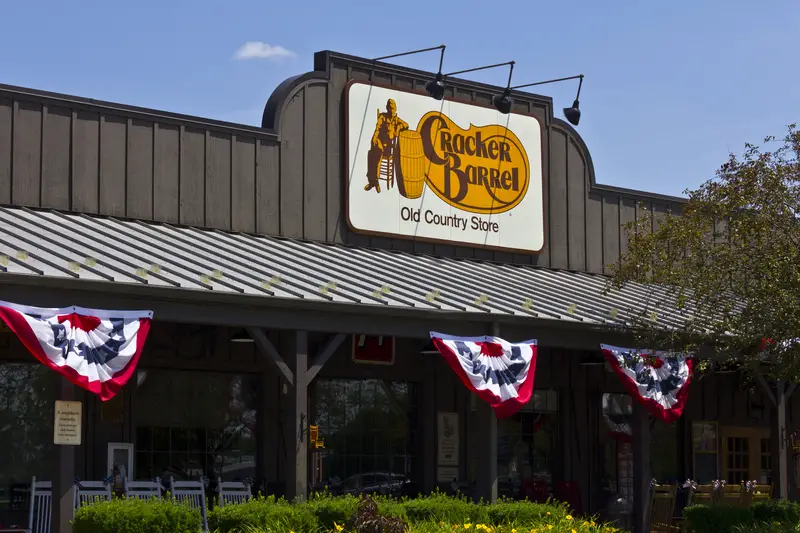
Cracker Barrel has been a fixture of American road trips and Sunday dinners for over fifty years. With its country store gift shop, rocking chairs on the front porch, and menu full of biscuits, gravy, and fried everything, the chain built an empire on nostalgia. Over 660 locations across 44 states. Billions in annual revenue. A brand so tied to Americana that messing with it felt like messing with grandma’s kitchen.
But behind the folksy charm, Cracker Barrel has a history that’s way more complicated — and way uglier — than most people realize. From openly discriminatory employment policies to a rebrand that cratered their customer base, here are the scandals that have defined Cracker Barrel as much as their hash brown casserole.
The 1991 Anti-Gay Employment Policy
This is the one that started it all, and it remains one of the most brazen corporate discrimination policies in modern American history. In 1991, Cracker Barrel’s corporate office issued a company-wide memo stating that employees “whose sexual preferences fail to demonstrate normal heterosexual values” were not welcome to work at the chain. It wasn’t a rumor or a leaked internal email. It was official company policy.
At least eleven employees were fired across multiple locations, simply for being gay. The firings were swift and unapologetic. Some employees were outed by coworkers or managers before being let go. The backlash was immediate. Queer Nation and other LGBTQ advocacy groups organized protests at Cracker Barrel locations across the South. There were sit-ins, boycotts, and national media coverage.
Here’s what made it even worse: Cracker Barrel rescinded the written policy relatively quickly after the PR firestorm, but the company refused to add sexual orientation to its non-discrimination policy for years. Shareholder resolutions pushing for inclusion were voted down repeatedly throughout the 1990s. The New York City Employees’ Retirement System, which held Cracker Barrel stock, pushed hard for a policy change and got stonewalled. It took until 2002 — eleven years — for Cracker Barrel to formally add sexual orientation to its nondiscrimination policy. And even then, many felt the company only did it because institutional investors were threatening to pull out.
The whole saga turned Cracker Barrel into a symbol of a very specific kind of corporate bigotry — the kind that wraps itself in down-home values and hopes nobody looks too closely at what those “values” actually mean.
Racial Discrimination Lawsuits That Cost Millions
The discrimination at Cracker Barrel didn’t stop with the LGBTQ community. Throughout the late 1990s and early 2000s, the chain faced a wave of racial discrimination complaints from both employees and customers. The allegations were damning: Black customers reported being seated in separate sections of the restaurant, being served food taken from the trash, receiving slower service, and being subjected to racial slurs from staff. Employees said they were passed over for promotions and subjected to a hostile work environment.
The U.S. Justice Department got involved. In 2004, Cracker Barrel settled a major federal investigation and agreed to a consent decree that required the company to overhaul its policies. The settlement included mandatory diversity training, a new system for tracking customer complaints, and the hiring of an outside monitor to oversee compliance. The chain didn’t admit wrongdoing — they never do — but the terms of the agreement told a very clear story.
Reports from the NAACP and individual lawsuits painted a picture of a company where racism wasn’t just tolerated — it was, in some locations, practically part of the restaurant’s culture. Multiple locations across the Southeast were named in complaints. For a chain that made its living selling the romance of the old South, the lawsuits forced an uncomfortable question: exactly which part of the old South were they selling?
The Noose Decoration Incident
Cracker Barrel’s restaurants are famous for the antique-style décor that covers every inch of wall space. Old signs, farm tools, vintage advertisements — the whole vibe is “your grandparents’ attic, but make it a restaurant.” Most of the time, nobody pays much attention to the individual items. But at a Connecticut location, one piece of décor caught a customer’s eye for all the wrong reasons.
A decoration hanging in the dining room looked, for all intents and purposes, like a noose. The customer raised the alarm, and the story went viral. Cracker Barrel’s response was that the item was a piece of historical décor — not intended to convey any message. But given the company’s existing track record on racial issues, a lot of people weren’t buying it.
Whether or not the decoration was genuinely innocent, the incident highlighted a deeper problem: when your brand is built around nostalgia for a particular era of American life, you have a responsibility to be careful about what artifacts from that era you’re putting on your walls. A noose — even an accidental one — carries a very specific and violent meaning in this country. The fact that nobody in management caught it before customers did said a lot.
The Nearly $700 Million Rebrand Disaster
Fast forward to more recent history, and Cracker Barrel found itself in a completely different kind of scandal — one that had nothing to do with discrimination and everything to do with losing touch with its own customers.
Cracker Barrel spent close to $700 million on a massive rebrand. New logo. Updated interior design. Menu changes. The company said it was trying to modernize and attract younger diners. The problem? The people who actually eat at Cracker Barrel didn’t want any of that.
The new logo removed traditional imagery that had been part of the brand’s identity for decades. The interior redesigns stripped out some of the antique clutter that made the restaurants feel like, well, Cracker Barrel. Long-time customers felt like the chain was abandoning everything that made it special. And they weren’t quiet about it.
The backlash was swift and brutal. Social media exploded with angry posts from regulars who felt betrayed. Conservative commentators jumped on it, framing it as another example of a beloved American brand going “woke.” Activist Robby Starbuck called it an attack on American culture and heritage. Glenn Beck’s social media posted about a “secret Cracker Barrel warehouse” that allegedly held the old décor items that had been removed from restaurants, framing it as evidence of a larger agenda.
Whether or not the “woke” framing was fair — the company said the rebrand was about business, not politics — the customer reaction was real and it hit the bottom line hard.
Republican Diners Bailed and the Numbers Collapsed
The financial fallout from the rebrand wasn’t just a temporary blip. Cracker Barrel’s core demographic — older, conservative, largely Southern and rural — started eating somewhere else. And the numbers showed it.
According to reports, Cracker Barrel dropped from being the fastest-growing breakfast chain to dead last as GOP-identifying diners abandoned the brand. That’s not a minor slide. That’s a freefall. The company had spent hundreds of millions trying to attract new customers and ended up driving away the ones it already had.
Cracker Barrel eventually started backtracking. The company acknowledged the backlash and began walking back some of the changes. But undoing a $700 million rebrand isn’t like returning a shirt to Target. The damage was done, and rebuilding trust with a customer base that feels like you sold them out is a long, slow process — if it works at all.
The whole episode became a case study in how not to modernize a brand. Cracker Barrel’s value was never about being trendy. It was about being the opposite of trendy. The chain survived for decades precisely because it didn’t change. Customers walked through those doors knowing exactly what they’d get: the same menu, the same décor, the same vibe they remembered from childhood road trips. When the company tried to mess with that formula, it broke the one thing it couldn’t afford to break — the emotional connection its customers felt to the brand.
What All of This Says About Cracker Barrel
Taken together, Cracker Barrel’s scandals tell the story of a company that has never quite figured out who it wants to be. In the 1990s, it leaned hard into a version of “traditional values” that included openly firing gay employees and tolerating racial discrimination. When it got called out, it made changes — slowly, reluctantly, and usually only when forced by lawsuits or investor pressure.
Then, decades later, it swung in the other direction. The rebrand felt like Cracker Barrel trying to distance itself from its own history — to become something sleeker, more modern, more palatable to a younger, more diverse audience. But it fumbled the execution so badly that it alienated its existing base without convincing anyone new to show up.
The irony is thick. A company that spent the 1990s discriminating against marginalized communities ended up losing its customer base thirty years later by trying too hard to look inclusive. Neither version of Cracker Barrel seems authentic. And in the restaurant business, authenticity is the whole ball game.
Cracker Barrel still has over 660 locations. The biscuits are still warm. The rocking chairs are still on the porch. But the brand is bruised in a way that menu specials and loyalty programs can’t fix. The scandals — from discrimination to decoration to disastrous rebranding — have left a mark. And for a company that sells nostalgia, having a past you’d rather forget is a real problem.
