

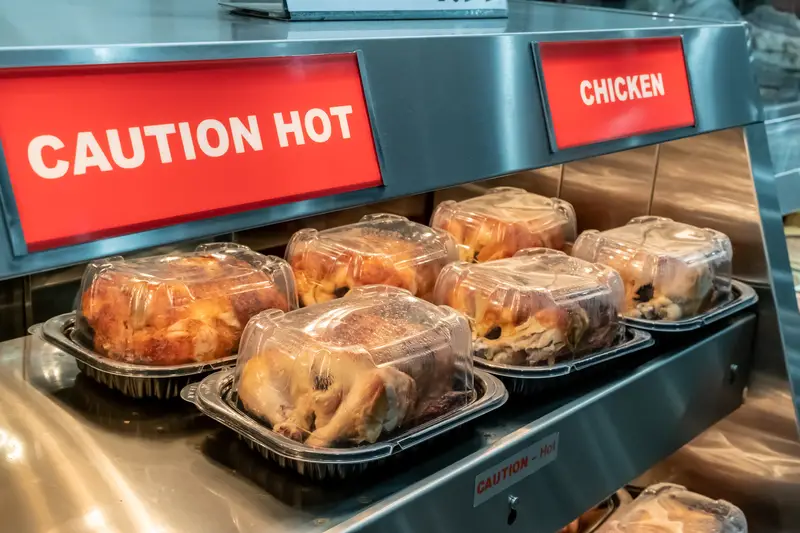
The $4.99 Costco rotisserie chicken might be the most iconic grocery item in America. It’s the reason half of us walk into that warehouse in the first place. You tell yourself you’re just going in for paper towels and maybe some of those frozen dumplings, and then you smell it — that golden, glistening bird sitting under the heat lamps near the back of the store. You grab one. Everyone grabs one. Costco sold 157 million of them worldwide in 2025 alone.
But now, that beloved chicken is at the center of not one but two class-action lawsuits, and the allegations aren’t pretty. One claims Costco lied about what’s in the chicken. The other claims the company’s own processing plant has been pumping out potentially contaminated birds for years. Together, these cases are putting serious heat on a product Costco has spent billions of dollars building its brand around.
The “No Preservatives” Label That Wasn’t Quite True
The first lawsuit landed on January 22 in a Southern California federal court. Two women — Bianca Johnston of Big Bear and Anatasia Chernov of Escondido — filed a complaint alleging that Costco falsely advertised its Kirkland Signature Seasoned Rotisserie Chicken as containing “no preservatives.” The problem? The ingredient list on the back of the packaging includes sodium phosphate and carrageenan — two additives that function, at least in part, as preservatives.
Sodium phosphate is commonly used to extend shelf life, retain moisture, and improve texture in processed meats. Carrageenan, which comes from red seaweed, is a thickener and stabilizer. Both are FDA-approved and appear in tons of prepared foods you probably eat all the time. But the lawsuit argues that slapping a “no preservatives” label on a product that contains ingredients with preservative functions is misleading — and that Costco knew it.
The complaint says Costco “systematically cheated customers out of tens, if not hundreds, of millions of dollars” through its in-store signage and online marketing. Both plaintiffs say they specifically prefer preservative-free food and wouldn’t have bought the chicken — or at least wouldn’t have paid the same price — if they’d known about the additives.
Costco Quietly Pulled the Signs Down
Here’s the part that caught my attention: within days of the lawsuit being filed, Costco removed all “no preservatives” references from its in-store signage and online presentations. The company framed it as a move to “maintain consistency among the labeling on our rotisserie chickens and the signs in our warehouses.” They also confirmed that they do use carrageenan and sodium phosphate, but said the ingredients are there for moisture retention, texture, and consistency during cooking — not preservation.
That’s a pretty fine line. The ingredients are approved. They’re common. But if you’re advertising something as preservative-free and then listing ingredients that preserve things right there on the label, you can see why a court might have something to say about it.
Interestingly, both plaintiffs said in their complaint that they still plan to buy Costco rotisserie chickens in the future. They just want the labeling to be honest. That’s a funny detail — it tells you something about how powerful the $4.99 chicken really is. Even the people suing Costco over it don’t want to give it up.
Then Came the Salmonella Lawsuit
Just three weeks later, on February 12, a second class-action lawsuit was filed in federal court in Seattle. This one is a different animal entirely. Where the first case is about marketing language, the second one is about food safety — specifically, chronic salmonella contamination at Costco’s own chicken processing plant.
The plaintiff, Lisa Taylor of Affton, Missouri, says she routinely bought one or two rotisserie chickens a month from Costco warehouses in the St. Louis area. She claims she overpaid because Costco never told customers about the contamination issues at the plant producing their chicken. The lawsuit seeks damages for anyone who purchased Costco rotisserie chicken or raw Kirkland Signature chicken parts dating back to January 1, 2019.
The Nebraska Plant With a Contamination Problem
To understand the salmonella lawsuit, you need to know about Lincoln Premium Poultry. In 2019, Costco opened a massive $450 million poultry complex in Fremont, Nebraska. It was a huge bet — a retailer building its entire chicken supply chain from scratch, from hatcheries and feed mills all the way through slaughter and processing. The goal was simple: keep the rotisserie chicken at $4.99 no matter what. The plant now processes more than 100 million chickens every year, exclusively for Costco.
The USDA rates poultry plants on a three-category system based on salmonella testing. Category 1 is the best. Category 3 means the plant has exceeded allowable contamination levels. According to the lawsuit and an analysis of USDA data, Costco’s Nebraska plant has received a Category 3 rating in 92 percent of reporting periods since it opened. The plant reportedly failed every single monthly salmonella test from late 2023 through mid-2025.
To put that in perspective: even the USDA’s passing standards allow for contamination in nearly 10% of whole chickens and over 15% of chicken parts. Costco’s plant is failing those already generous thresholds almost all of the time.
The $4.99 Price Tag Has Always Been the Point
Costco’s rotisserie chicken has been $4.99 since 2009. That’s sixteen years at the same price while everything else — gas, eggs, rent, a cup of coffee — has gone through the roof. The chicken is a loss leader, meaning Costco loses money on every single bird. The strategy is that once you’re in the store for a cheap chicken, you’ll also pick up a $200 patio set and a case of wine on your way out.
That loss-leader math is why Costco built the Nebraska plant in the first place. When outside suppliers couldn’t keep costs down, Costco decided to do it themselves. But the lawsuit alleges that the obsession with maintaining that price point came at the expense of food safety. The complaint states that what began as a strategy to keep prices low “has spiraled into a serious public health concern.”
Animal Welfare Issues Have Been Brewing for Years
The salmonella and preservative lawsuits aren’t even the first legal trouble connected to Costco’s chicken operation. Back in June 2022, two Costco shareholders filed a separate lawsuit in Washington State’s King County Superior Court. That case alleged that Costco executives were causing the company to violate Nebraska and Iowa livestock neglect laws through its poultry production practices.
The 2022 complaint accused Costco of intentionally breeding chickens so large they can’t stand on their own. It alleged that disabled birds couldn’t reach food or water and slowly died from hunger, injury, and illness. In 2021, the animal welfare group Mercy for Animals released undercover footage from a Costco chicken farm in Nebraska showing injured and deformed birds in overcrowded conditions. According to Farm Forward’s analysis, 7.2 million chickens die from disease or mistreatment before even reaching slaughter at the Nebraska facility every year.
What the Lawsuits Are Actually Asking For
The preservative lawsuit is seeking class certification for two groups: anyone in the U.S. who bought a Costco rotisserie chicken, and a sub-class of California buyers. It brings claims under the California Consumers’ Legal Remedies Act, the California Unfair Competition Law, the California False Advertising Law, and the Washington Consumer Protection Act. The plaintiffs want unspecified monetary damages and a jury trial.
The salmonella lawsuit is seeking compensatory and triple damages for anyone who bought Kirkland Signature rotisserie chicken or raw chicken parts since January 1, 2019. It cites violations of Washington consumer protection laws and argues that Costco broke an implied promise that its chicken is safe to eat. Neither lawsuit claims that every individual chicken was contaminated or harmful — instead, they focus on whether Costco’s practices and marketing were honest.
Costco Hasn’t Said Much
Costco’s public response to all of this has been minimal. On the preservatives issue, the company acknowledged using sodium phosphate and carrageenan and quietly removed the “no preservatives” signage. On the salmonella lawsuit, Costco hasn’t publicly detailed any response, and the case is still in its early stages. Lincoln Premium Poultry, which is not named as a defendant, also didn’t respond to media requests for comment.
Both cases could take years to work through the courts. Class-action certification alone is a long process, and Costco has the legal resources to fight these battles for as long as it takes. But even if the lawsuits don’t result in massive payouts, the reputational damage is real. The $4.99 rotisserie chicken isn’t just a product for Costco — it’s a symbol. It’s the thing that makes people feel like their membership is worth it. It’s the reason people drive past three other grocery stores to get to a Costco. And right now, that symbol is looking a lot less golden than it used to.
