

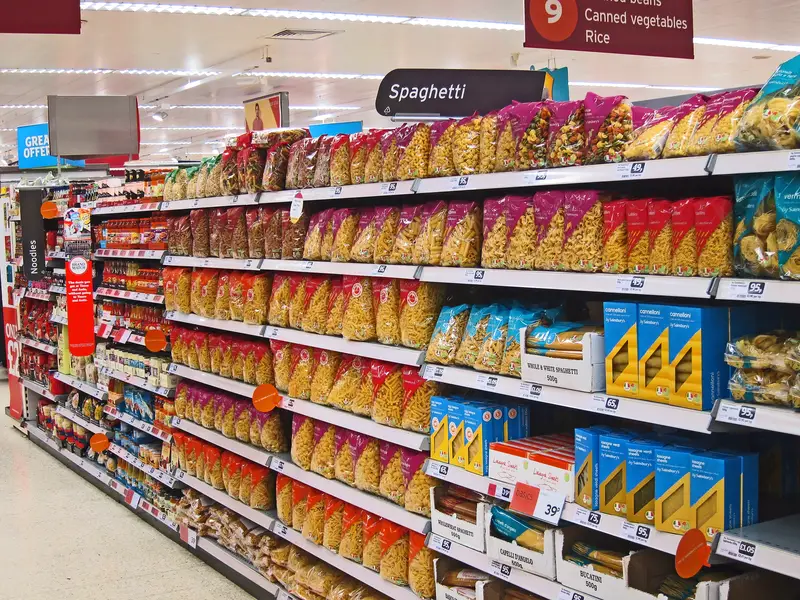
Here is the thing nobody wants to admit in the pasta aisle: spaghetti is not just spaghetti. Most of us grab whatever is cheapest or whatever our mom used to buy, toss it in the cart, and assume a noodle is a noodle. It is not. Two boxes can sit side by side on the same shelf, same shape, nearly identical ingredient lists, and one will make your sauce cling like a dream while the other turns your dinner into a soupy, slippery mess. According to the folks over at Vincenzo’s Plate, the difference has almost nothing to do with the logo and everything to do with how the pasta was made long before it hit your kitchen.
So let’s rank the popular boxed spaghetti brands from the one you should genuinely avoid at all costs, all the way up to the box that is actually worth your money. Grab a fork.
8. Great Value (The One to Avoid at All Costs)
If you take one thing away from this article, make it this: Walmart’s Great Value spaghetti lands dead last, and it is not close. The taste tests are brutal on this one. The noodles turn mushy before they ever reach al dente, they fall apart into sad little fragments instead of long strands, and they refuse to hold sauce. You end up with a bowl of naked pasta and a puddle of marinara at the bottom.
The price is the whole pitch here. A standard 16-ounce box runs about a dollar at Walmart, which is tempting when you are feeding a crowd. But the flavor is the letdown. Reviewers describe it as bland, forgettable, and carrying a faint cardboard aftertaste that gets worse as the dish cools. The culprit is the manufacturing. Budget brands rush the drying process, cutting it down to two or three hours with ultra-high heat instead of the slow low-temperature drying quality makers use. That shortcut wrecks the pasta’s structure. Pair that with a slick Teflon die that leaves the surface too smooth to grip anything, and you have a noodle that looks fine in the box and collapses in the pot. Skip it.
7. San Remo
Do not let the Italian-sounding name fool you. San Remo talks a good game with its branding, but the pasta inside contributes zero wheat flavor. It is a blank canvas in the worst way, offering nothing on its own and leaning entirely on whatever you pour over it.
The bigger problem is the texture. These strands go waterlogged fast, and within a couple of minutes of sitting in sauce they turn into slippery slides that let everything glide right off. Like most budget-tier boxes, San Remo blasts its pasta at extreme temperatures to speed up production, which destroys the gluten structure that gives a good noodle its springy bite. It is a small step up from Great Value only because the noodles do not disintegrate quite as dramatically, but that is a low bar to clear. If you care at all about your dinner, keep walking.
6. Creamette
Creamette is pure nostalgia. If you grew up in America, you have almost certainly seen this box in a pantry somewhere, maybe your grandmother’s. And look, there is nothing wrong with a little sentimental attachment. But Creamette strays far from the qualities that make real Italian pasta worth eating.
It is a middle-of-the-road mass-market noodle built for convenience and shelf life, not for flavor or texture. It will not embarrass itself in a weeknight bake where cheese and sauce are doing the heavy lifting, and it cooks predictably enough. But it brings nothing memorable to the plate. No nutty wheat character, no satisfying chew, no reason to reach for it over anything higher on this list. It is the definition of fine, and fine is not why you are reading a ranking article. Consider it a slight upgrade from the store brands, but only just.
5. Colavita
Here is a brand people assume is a safe bet because of its heritage, and that is exactly why it is a surprise letdown. Colavita started as an olive oil producer back in the 1930s in a small Italian village and became the first company to import extra virgin olive oil to the United States. Impressive resume. The pasta, though, feels like an afterthought.
On paper it sounds promising. The semolina wheat gives it a mild umami quality, and the noodles are structurally sturdy enough to stand up to a hearty ragu. But in practice, any pasta character gets completely overwhelmed by even the gentlest seasoning. Add a pinch of anything and the noodle vanishes into the background. The spicy chefs also flagged a faint floury aftertaste in Colavita’s cuts and noted that cooking it by the box directions often leaves you with overdone noodles. It is functional. It is just not exciting, and for the price you can do better.
4. Barilla
Now for the big one, the brand almost everyone in America reaches for on autopilot. Barilla, the iconic blue box, is not bad exactly. It is consistent, widely available, and predictable, which is precisely why so many restaurants keep it on hand. But consistency is not the same as greatness.
Barilla is built for speed and scale, and that comes at a cost. It uses smooth Teflon extrusion, so the surface of the strand is slick and shiny, which means your sauce tends to slide right off instead of grabbing on. Vincenzo’s Plate put it bluntly, calling Barilla perfectly fine for a quick midweek meal but wrong for sauce-driven dishes like carbonara where the pasta and sauce need to become one. The high-temperature drying also sacrifices depth of flavor, and Barilla has a habit of softening a touch too fast, losing that springy bite. It ranks in the middle here because it is reliable and never truly offensive. But if you have been treating it as the gold standard, that is the real surprise of this list.
3. De Cecco
This is where the ranking turns a corner and things start tasting like actual pasta. De Cecco is the one you can grab at a regular grocery store that still delivers real quality. The reason is the manufacturing. Instead of the slick industrial shortcuts, De Cecco uses traditional bronze-die extrusion and more careful drying, which gives you properly textured noodles that hold their shape and actually cling to sauce.
Bronze dies matter more than most shoppers realize. As the pasta nerds at Pastasty explain, bronze creates friction that roughs up the surface, leaving thousands of tiny ridges for sauce to grab. The one thing to know is that De Cecco’s whole wheat version has a coarse, grainy mouthfeel and a bold flavor that can bulldoze a delicate sauce, so stick with the classic semolina spaghetti. That box gives you a firm, satisfying bite that mass-market brands simply cannot match. It is the smart everyday upgrade.
2. Garofalo
Garofalo has been making pasta since 1789, and it shows. This brand uses 100 percent Italian durum semolina and is repeatedly cited as one of the few grocery-accessible boxes that delivers genuine quality. If you spot it at a well-stocked market or an Italian grocer, grab it.
What sets Garofalo apart is the balance. The wheat has real character, that nutty, slightly sweet quality that makes good pasta enjoyable even plain, and the bronze-cut texture gives sauce something to hold. You will notice the strands look dull and matte in the package rather than shiny and translucent, which is a dead giveaway of quality. As Pastasty points out, a dull matte finish means bronze extrusion, while a shiny, see-through strand means it was pushed through a slick Teflon die for factory speed. Garofalo passes that test with ease. It costs more than the blue box, but the jump in flavor and texture is obvious on the very first bite. This is a brand that respects the plate.
1. Rustichella d’Abruzzo (The Winner)
The best boxed spaghetti you can buy is Rustichella d’Abruzzo, and once you taste it next to everything else on this list, the gap is almost comical. This is what happens when a producer refuses to cut corners. The pasta is slow-dried at low temperatures for more than 50 hours, compared to the two or three hours budget brands rush through.
That patience is everything. According to the drying specialists at Zhuoheng, traditional low-temperature drying removes moisture without cooking the pasta, preserving the structure that gives you a proper al dente bite. High heat does the opposite, damaging the starch and leaving you with mushy, flavorless strands. Rustichella pairs that slow drying with a bronze die that carves thousands of sauce-gripping ridges into every strand. In side-by-side cook tests it holds its firmness a full three minutes past the point where budget brands have already turned to glue. That is the difference between a noodle that forgives you and one that punishes you. It is a splurge, no question. But for a special dinner or any dish where the sauce and pasta need to truly marry, nothing on a grocery shelf beats it.
The Bottom Line
You do not need to buy the priciest box every single night. The smart move is keeping both a solid budget option and a premium one in the pantry, then matching the pasta to the occasion. For a quick weeknight bowl, De Cecco is your friend. For something you actually want to show off, reach for Garofalo or Rustichella d’Abruzzo. And whatever you do, leave the Great Value box on the shelf. A dollar is not a bargain when dinner ends up in a puddle at the bottom of the bowl.
