

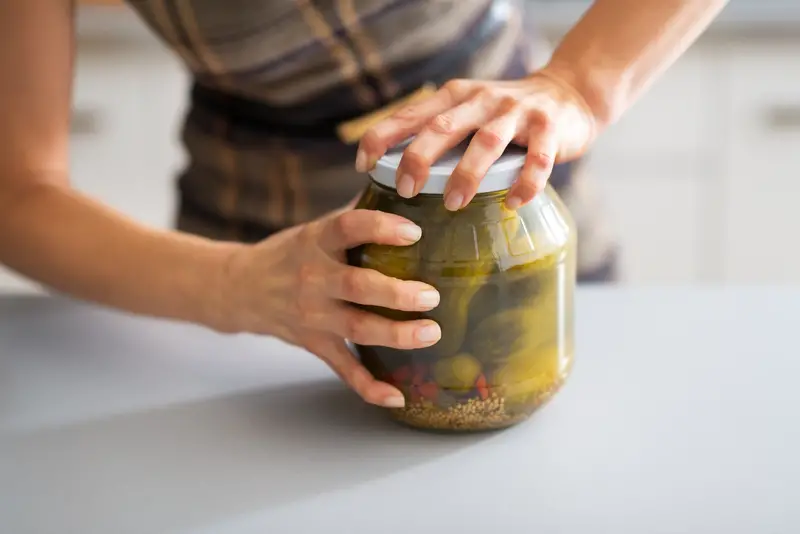
That jar of pickles sitting in your fridge has been staring you down for three days now. The lid won’t budge no matter how hard you twist, and asking someone else to open it feels like admitting defeat. Here’s something most people don’t realize: you’re probably making it harder than it needs to be. Those factory seals aren’t unbreakable, and you don’t need superhuman strength to pop them open. With a few simple tricks that take less than a minute, you’ll never have to wrestle with a stuck lid again.
Hot water makes metal lids expand slightly
Metal and glass react differently to heat, which works in your favor when dealing with stubborn jars. When you run hot water over a metal lid, it expands just enough to loosen its grip on the glass rim. This isn’t about melting anything or making dramatic changes—it’s just basic physics working for you instead of against you. Hold the jar upside down under hot running water for about 30 seconds, making sure the water covers the entire lid area. The metal will warm up and expand while the glass jar stays relatively cool.
If you don’t want to waste water running the tap, fill a bowl with hot water and place the jar lid-side down for about a minute. After heating the lid, grab a dry towel to protect your hands and twist. The combination of heat expansion and better grip usually does the trick on the first try. Some people even use a hairdryer pointed at the lid for 20-30 seconds if they’re in a hurry and don’t want to deal with water at all.
Rubber bands create instant traction on slippery surfaces
Ever notice how those thick rubber bands around broccoli bunches at the grocery store seem indestructible? They’re perfect for gripping jar lids. Wrap one of those fat rubber bands around the lid, making sure it’s snug and covers a good portion of the surface. The rubber grips the metal in a way your bare hands simply can’t, especially if your hands are slightly damp or the lid has condensation on it. You can also slip on a pair of rubber dishwashing gloves, which work on the same principle but cover your entire hand.
Silicone pot holders or those grippy shelf liners you use in kitchen drawers work just as well. Some people keep a small square of that rubbery shelf liner material specifically for opening jars, and it never fails them. The material doesn’t slip like fabric towels do, and it distributes pressure evenly across the lid surface. If you’re really struggling, try using two rubber bands—one around the lid and another around the jar itself for better grip with both hands.
Tapping the lid breaks factory vacuum seals
That satisfying pop you hear when opening a new jar isn’t just for show—it’s the sound of the vacuum seal breaking. When jars get sealed at the factory, they create an airtight environment that keeps food fresh but also makes lids incredibly difficult to remove. A few firm taps with a wooden spoon or the handle of a butter knife can disrupt that seal just enough to make opening easy. Turn the jar upside down and tap around the edge of the lid at four evenly spaced points, like you’re marking the corners of a square.
Listen carefully while tapping—you might hear a faint popping sound that tells you the seal has given way. Some people prefer to tap the bottom of the jar while it’s right-side up, which can also work by shifting the contents and creating pressure changes. The key is being firm without going overboard and potentially damaging the jar. After tapping, try opening it again with a towel for grip. If it still won’t budge, try the tapping method combined with one of the other tricks for double effectiveness.
A butter knife can pry the seal loose
When tapping doesn’t work, it’s time to get more direct about breaking that seal. Take a butter knife or a bottle opener and carefully wedge the tip under the rim of the lid. You’re not trying to pry the entire lid off—just lift it slightly away from the jar rim to let air in and break the vacuum. Work your way around the lid, inserting the tip at different points and applying gentle upward pressure. Keep the knife pointed away from you and be careful not to slip, as the metal can be slippery.
The goal is to hear that telltale hissing or popping sound that means air is rushing in. Once you hear it, the hard part is over. The seal is broken, and the lid should twist off easily with your normal grip. A flat-head screwdriver works even better than a butter knife if you have one handy, since it’s designed for leverage. Just be gentle with glass jars—you want to pop the seal, not chip the rim or crack the glass.
The water hammer technique uses pressure changes
This method sounds more complicated than it actually is. Hold the jar in your non-dominant hand and tilt it at a 45-degree angle with the lid facing downward. Using the center of your palm, give the bottom of the jar a firm but controlled smack. What happens is the liquid inside shifts suddenly, creating a pressure change near the lid that can break the seal. It’s the same principle behind smacking the bottom of a ketchup bottle to get it flowing, just applied to jar opening.
Don’t hit it so hard that you risk breaking the glass—a solid thwack is all you need. You should hear a small pop if it works, which means the seal has released. This technique works best with jars that have liquid contents, like pickles or olives, rather than thick substances like peanut butter. If you don’t hear the pop on the first try, give it another go. Some people find this method easier than others, so it might take a bit of practice to get the angle and force just right.
Dry towels work better than you think
Sometimes the simplest solution is the most effective. If your hands are even slightly damp or sweaty, your grip strength drops significantly. A completely dry dish towel wrapped around the lid gives you the friction you need without any fancy tools or techniques. Make sure the towel is thick enough that it won’t slip, and wrap it tightly around the entire lid. Cotton towels with a bit of texture work better than smooth ones, and anything with a waffle weave pattern is especially good for gripping.
The trick is to dry both your hands and the lid completely before attempting this. Any moisture creates a slippery surface that defeats the purpose. Twist with steady, even pressure rather than jerky movements. If you’re using this method after heating the lid with hot water, make absolutely sure both the lid and towel are dry before you try opening it. The combination of heat expansion and a good dry grip succeeds more often than people expect.
Electric jar openers do the work for you
If you regularly struggle with jar lids or just want to skip the hassle entirely, battery-operated jar openers are worth every penny. These gadgets position on top of the lid, and with the press of a button, they automatically twist it off. No grip strength required, no techniques to remember, and no risk of hurting your hands. They’re especially helpful if you have arthritis or any condition that makes gripping difficult. Most models work on multiple lid sizes, from small jam jars to large pickle containers.
You can find these electric openers at most major retailers for around twenty to thirty dollars, and they run on regular AA batteries. Some people keep one in their kitchen drawer and another in their RV or vacation home. There are also manual jar opening gadgets that use leverage rather than batteries—these mount under cabinets and work by gripping the lid while you turn the jar. Both types make jar opening completely effortless and save your hands from the strain of repeated twisting.
Under cabinet openers mount permanently for easy access
These clever devices install on the underside of your kitchen cabinets and stay there permanently, ready whenever you need them. They look like small V-shaped metal pieces with teeth or gripping surfaces. To use one, you simply fit the jar lid into the V-shape, hold the jar steady, and twist. The device grips the lid while you rotate the jar body, using leverage to make opening effortless. Installation takes just a few screws and about five minutes of your time.
Most models adjust to fit different lid sizes, from tiny jam jars to large pasta sauce containers. They don’t take up any drawer or counter space, and once they’re installed, you’ll wonder how you lived without one. These are particularly popular with people who cook frequently and go through lots of jarred ingredients. The best part is they never need batteries or maintenance—just mount them once and use them for years. Some versions even include multiple opening sizes on one device, so you’re covered no matter what size jar you’re dealing with.
Plastic wrap creates friction without leaving residue
This might seem odd, but plastic wrap works surprisingly well for getting a grip on stubborn lids. Tear off a piece about a foot long and bunch it up around the lid, creating a thick, grippy surface. The plastic creates friction against the metal without slipping like fabric sometimes does. It’s especially useful when you’re dealing with those small jam or jelly jars where there’s not much surface area to grip in the first place. The bunched-up plastic fills your palm and gives you something substantial to hold onto.
Unlike rubber bands that you need to keep around specifically for jar opening, plastic wrap is something almost everyone already has in their kitchen. It doesn’t leave any sticky residue on the lid, and you can just toss it when you’re done. Some people prefer this method over towels because the plastic creates more consistent friction across the entire lid surface. Try combining this with the hot water method for particularly stubborn jars—heat the lid first, dry it off completely, then use plastic wrap for your grip. The combination rarely fails.
Dealing with stuck jar lids doesn’t have to be a test of strength or a source of frustration anymore. Whether you’re using hot water to expand the metal, rubber bands for better grip, or investing in a handy gadget that does the work for you, there’s a solution that fits your situation. The next time you’re facing down a stubborn jar of marinara or pickles, you’ve got an entire toolkit of methods to try. Pick the one that seems easiest for what you have on hand, and that lid will be off before you know it.
