

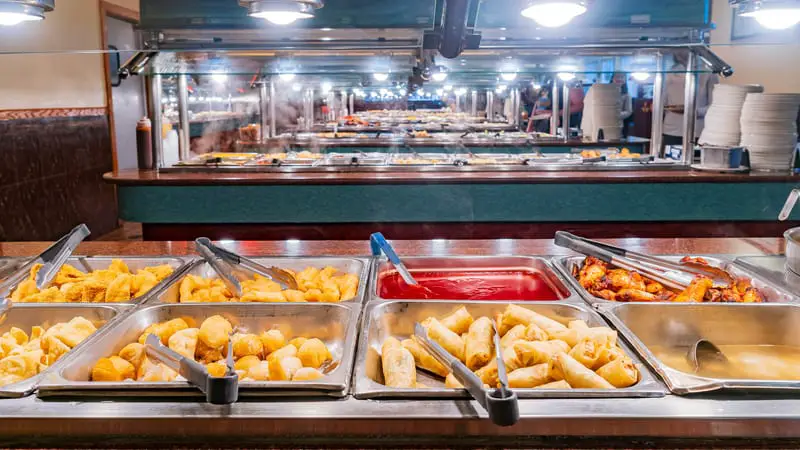
The sneeze guard fogs over around seven o’clock, the trays start getting topped up instead of swapped, and the tongs in the lo mein have not moved in twenty minutes. That is the hour when a Chinese buffet stops being a bargain and starts being a question of where you spend your plate space. Most of the line is simply uneven, some trays worth a second trip and some of them cheap filler sold at a flat rate. One corner is not worth your plate at all, and it is the cold station: the sushi rolls, the crab legs and the oysters sitting on ice that went soft an hour ago.
9. Buffet Sushi, Oysters and Crab Legs
Raw fish and shellfish are the two things on any menu that live or die on freshness and tight temperature control, and a steam table operation is built for neither. Sushi rice dries out quickly once it is sitting on an open tray. Delicate fillings lose their aroma and their texture. Crab legs often sit well past their prime, and oysters are the one item on the line that nobody can judge by looking at it.
Tampa supplies the blunt example. On July 10, 2026, the Florida Department of Health named China Buffet at 1245 E. Fowler Avenue as the likely source of a Listeria outbreak. Five people got sick, and four of them had eaten there between March and June. Swabs taken inside the restaurant turned up the outbreak strain of Listeria monocytogenes. The advisory did not name a specific dish, and no public update has followed.
That restaurant’s paperwork from the same stretch is its own argument for skipping the cold station anywhere. State inspectors kept writing the place up after the advisory, too, including a July complaint inspection that logged 10 high-priority violations. Regulators have not tied any single violation to the outbreak.
8. Crab Rangoon
No item on the line is better marketed or cheaper to produce. Crab rangoon is dough, cream cheese and imitation crab, folded into a triangle and dropped in the fryer. Real crab is rare at buffet pricing, so the thing you are reaching for is a fried wrapper around soft cheese and surimi.
Taste it cold and the illusion collapses completely. The flavor is cream cheese and frying oil, with the sweet dipping sauce doing the rest of the work. Fresh out of the fryer they are genuinely good, which is the trap, because the ones on the tray have been there a while and the wrapper has already turned leathery at the folds.
Two of them as a snack is fine. Four of them is a plate of fried dough you did not intend to order, and it is plate space you cannot get back on a fixed-price meal.
7. BBQ Spare Ribs
The glaze is the dish. Strip the sticky red-brown coating off a buffet spare rib and what remains is a thin strip of meat on a bone, and the bone is coming home on your plate whether you want it or not. A full sit-down restaurant order can carry more sugar than a can of soda, which tells you exactly which flavor is doing the heavy lifting.
Ribs also punish you on arithmetic. You are paying one price for access to the whole line, and the ribs are the item with the worst meat-to-weight return anywhere on it. Three ribs look like a serious plate and eat like an appetizer.
Take one, judge it, and move on. If the glaze has gone tacky and dull at the edges of the tray, that pan has been sitting, and the next one is not far off.
6. Sweet and Sour Pork
Sweet and sour pork is candy in a steam tray, and the number backs it up: one restaurant order can carry about 63 grams of sugar, roughly 16 teaspoons. That syrup is not an accident of flavor. It is the thing standing between you and the quality of the pork underneath, and at buffet prices there is a reason the kitchen wants a curtain there.
The pork itself is deep-fried before it ever meets the sauce, so it drinks oil first and syrup second. By the time it reaches the tray, the batter has gone soft and the whole piece is sweet all the way through.
Order it fresh at a sit-down place and it has a crunch worth eating. On a buffet line it is dessert wearing a dinner costume, and most people figure that out three bites in.
5. General Tso’s Chicken
The most popular tray is also the one that falls apart fastest. General Tso’s is built entirely on contrast, crisp fried coating against a glossy sticky sauce, and that contrast has a short lifespan once the two are sitting in a pan together under a lamp. The sauce soaks into the batter, the batter goes soft, and the crunch the dish depends on is gone.
What is left is sweet coating with some chicken inside it. The sauce is doing roughly the same job it does in sweet and sour pork, which is covering for everything beneath it.
If the tray was just refilled and the pieces still look separate rather than fused into a glazed mass, it is worth a few pieces. If it looks like one solid orange sheet, it has been sitting, and you are about to spend prime plate real estate on wet breading.
4. Egg Rolls
An egg roll is excellent for about two minutes and merely acceptable after that. Steam builds up inside the wrapper as it sits, and that steam works from the inside out, turning a crisp shell limp and greasy while you are still deciding whether to take one.
You are also paying mostly for the wrapper. The filling is shredded vegetables and not much else, and the sugary dipping sauce is there to give it a flavor it does not have on its own.
Check how they are stacked before you commit. Rolls piled on top of each other are steaming one another, and the ones at the bottom of the pile are already soft. The ones standing separately in a single layer still have a chance.
3. Fried Rice and Lo Mein
The starch trays sit at the front of the line for a reason: they are the cheapest thing in the building, and a plate filled with them is a plate you did not fill with anything else. That is the whole economics of a buffet in two pans.
Neither one survives the tray. Fried rice is white rice stir-fried in oil and soy sauce, and as the pan sits, steam makes the grains swell and clump while oil pools at the bottom. Lo mein keeps absorbing sauce until the noodles swell and knot into a sticky mass, and the flavor flattens out as it goes.
Neither is a problem, exactly. They are just the worst value per square inch on the line. If you want them, take a small scoop at the end rather than a mound at the beginning, and take it from a pan that was just set down.
2. Egg Drop and Wonton Soup
Clear broth is the one thing a steam table cannot ruin, because soup is already supposed to sit in hot liquid. Egg drop and wonton soup taste the same at eight o’clock as they did at six, which is more than any fried item on the line can claim.
A bowl first also changes how the rest of the meal goes. It slows you down before you reach the glazed trays, and it costs you nothing on a fixed-price ticket.
The only thing to watch is the ladle. If the wontons have broken apart and the broth has gone cloudy with starch, that pot has been going a long time.
1. Steamed Vegetables and Unbreaded Protein
The far end of the line, where the pans are smaller and nobody is crowding, is where the buffet actually earns its price. Steamed broccoli, bok choy and snow peas, grilled chicken or fish that has not been breaded, shrimp without a batter jacket, baked or steamed tofu, and a small scoop of plain white or brown rice. These are the items that cost the kitchen real money, which is exactly why the trays are smaller and further away from the entrance.
They are also the only things on the line that taste like themselves an hour later. Nothing here depends on a crust that has already collapsed or a sauce covering for the protein underneath. Keep the sauce light, since a heavy ladle of the sweet stuff undoes the only dish on the line you did not have to negotiate with.
One rule applies to the whole room: go when it is busy. A packed dining room means pans get emptied and replaced, and a tray that is constantly being replenished is the only tray worth your plate. An empty buffet at nine o’clock is the same food, several hours older, at the same price.
